

More remains found long after Jeju Air crash
More remains found long after Jeju Air crash
Posted March. 14, 2026 12:57,
Updated March. 14, 2026 12:58
More than 14 months after the Dec. 29 Jeju Air passenger plane crash that killed 179 people in late December 2024, the remains and personal belongings of victims are still being discovered.
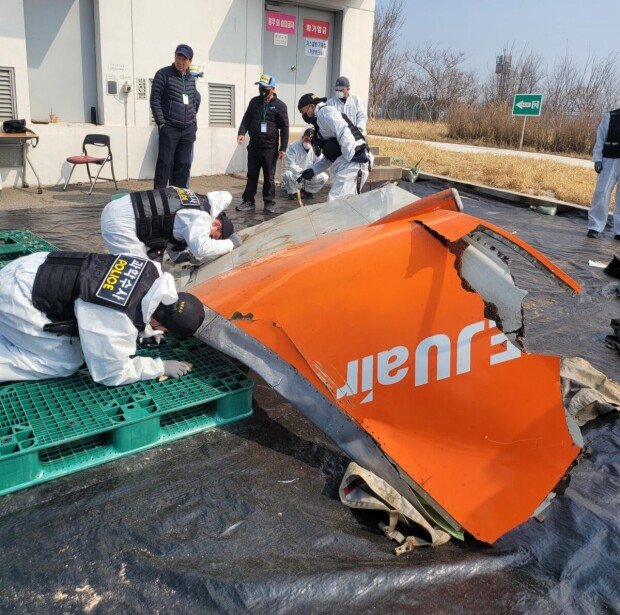
During a joint government reinvestigation launched last month into wreckage stored at Muan Airport, officials uncovered 64 items believed to be human remains. DNA testing has confirmed that nine of the pieces belong to seven victims, while analysis of the rest is ongoing. Traces of the victims that grieving families had searched for so desperately were left abandoned among piles of debris.
At the time of the disaster, authorities searched the crash site and nearby areas for nearly a month and recovered about 1,000 fragments of human remains. Among the wreckage collected, the aircraft’s main engines and several key components were removed for detailed investigation. The rest, judged to be of lesser importance, were placed in sacks and left in storage. Only after bereaved families repeatedly urged officials to review the debris, warning that remains or personal belongings could still be mixed in, did the government begin reclassifying the materials last month. The process quickly produced further discoveries. One of them was a leg bone about 25 centimeters long. In January last year, the Ministry of Land, Infrastructure and Transport declared that 99 percent of the debris recovery had been completed. That statement now invites serious scrutiny.
The delayed discoveries have forced some families to prepare for a third farewell to their loved ones. Immediately after the disaster in January last year, families held individual funerals. In February, additional traces found at the crash site were gathered and laid to rest during a joint memorial service. One bereaved family member spoke in anguish, saying grass has already grown thick over his father’s grave and asking whether he must now exhume the burial site and hold another funeral. Had the government heeded the families’ repeated appeals earlier, such a heartbreaking situation might have been avoided.
Past disasters reveal a similar pattern. After the 1995 Sampoong Department Store collapse, the Seoul city government buried the wreckage at the Nanjido landfill. Bereaved families searched through the trash with their own hands to recover remains. In the 2003 Daegu subway arson disaster, human remains were also found in piles of waste at a storage yard. Decades have passed, yet the lack of care in handling disaster victims appears to have changed little.
Authorities must examine the remaining wreckage to the very end with the resolve not to overlook even a single fragment of human remains. A thorough investigation is also needed into the flawed recovery work in the early stages of the disaster and how the remains were left unattended for so long. That would be the minimum respect owed to families whose lives have remained frozen on that day.

![[김순덕 칼럼]이 대통령은 왜 ‘탄핵 가능성’을 언급했을까](https://dimg.donga.com/c/138/175/90/1/wps/NEWS/IMAGE/2026/06/17/134133459.1.jpg)
![[단독]선관위, 결재없이 55억 써도 고작 견책…‘자체 징계’ 솜방망이](https://dimg.donga.com/c/138/175/90/1/wps/NEWS/IMAGE/2026/06/19/134138827.4.jpg)


 About Dong-A Ilbo