

New York parks define urban life
New York parks define urban life
Posted April. 29, 2026 07:40,
Updated April. 29, 2026 07:40
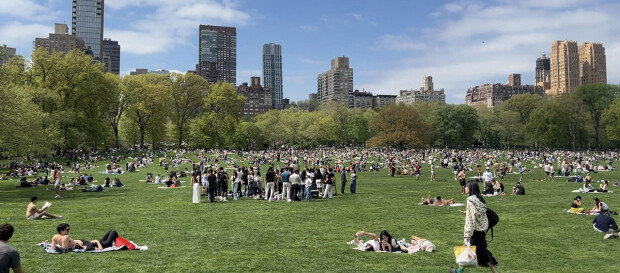
On April 18, Sheep Meadow in Central Park in Manhattan drew thousands of people out for the weekend.
The lawn, spanning more than 18,000 pyeong, about the size of nine soccer fields, was filled with a cross-section of the city. Tourists rolled suitcases across the grass. Couples stretched out on blankets. Groups of friends gathered for impromptu parties. An elderly woman sunbathed alone in a bikini. People of all ages and backgrounds enjoyed the spring sunshine in their own way.
Manhattan may be defined by its skyline of towering buildings, but residents do not experience it simply as a concrete jungle. That is in large part due to the city’s extensive network of parks, from landmark spaces like Central Park to smaller neighborhood green areas known as pocket parks.
● Parks as shared civic space
Central Park is the city’s most recognizable green space, but Manhattan alone has more than 300 parks. According to the New York City Department of Parks and Recreation, 99 percent of residents live within a 10-minute walk of one, placing access among the highest in major global cities.
From the beginning, parks in New York were designed as more than greenery. The modern system dates to 1853, when land was set aside for Central Park. Its designer, Frederick Law Olmsted, described it as a physical expression of democracy and a way to ease class tensions.
At the time, rapid industrialization and deteriorating urban conditions left most workers without access to private outdoor space. City leaders saw parks as one of the few places where residents could gather in a natural setting, interact freely and maintain a sense of dignity.
Central Park was built on a grand scale, stretching about 0.8 kilometers wide and 4 kilometers long, with winding paths designed to slow foot traffic and encourage chance encounters.
That vision still holds. New York’s parks draw people from all walks of life, from residents of luxury homes to tourists, artists and the homeless. In one of the world’s most expensive cities, these spaces remain open to all.
● From small lots to elevated parks
The same philosophy shapes parks across the city. New York has worked to ensure that green space is available close to home, regardless of neighborhood.
One result is the pocket park, introduced in the 1960s as land prices rose and large sites became scarce. The city began converting vacant lots and overlooked spaces into small parks.
These compact spaces, often between 50 and 200 pyeong, are now scattered throughout Manhattan. It is often said that a park appears every five minutes on foot.
Surrounded by tall buildings, many pocket parks feel quiet and enclosed, more like courtyards than public spaces. Fountains and small waterfalls help mask city noise and create a calmer setting.
They fill with office workers at lunchtime and draw readers, friends and dog walkers throughout the day. They serve as everyday retreats in the middle of the city.
New York has also transformed existing infrastructure into green space. In 2009, a disused elevated railway was turned into the High Line, now a major attraction that draws about 8 million visitors each year. Another example is Little Island, an artificial island park built on the Hudson River atop distinctive tulip-shaped supports.
● Parks sustained by the community
What sets New York’s parks apart is not only how they are built but how they are maintained. Creating a park is one step. Keeping it active as a shared space requires ongoing effort.
Residents play a central role. Many New Yorkers offer policy ideas, donate funds or volunteer their time to care for local parks.
The High Line itself began as a grassroots effort. Joshua David and Robert Hammond met at a public meeting on plans to remove the railway and formed Friends of the High Line. Their campaign helped transform the structure into a park where greenery now grows along the former tracks. Maintenance work continues today with both staff and volunteers.
Volunteer activity is also strong in pocket parks. Elizabeth Street Garden in Nolita has long served as a neighborhood gathering place. With many residents living in compact housing, such spaces function as informal living rooms where people meet, relax or read.
Some of these parks have recently been considered as sites for low-income senior housing, prompting opposition from local residents. Community members have organized petitions, staffed information booths and sold merchandise to support preservation efforts.
New Yorkers also use parks as year-round venues. At Bryant Park, one of the most heavily used parks in the world by area, the lawn hosts free yoga classes and outdoor film screenings in summer, then becomes an ice rink and holiday market in winter.
Central Park offers seasonal programming throughout the year, from spring cherry blossom events to summer concerts, fall marathons and winter ice skating. These activities help make New York an appealing destination in every season.
Woo-Sun Lim imsun@donga.com



![[오늘의 운세/7월 2일]](https://dimg.donga.com/c/138/175/90/1/wps/NEWS/IMAGE/2026/07/02/134221102.1.jpg)


 About Dong-A Ilbo