

Families urge renewed probe into crash
Families urge renewed probe into crash
Posted April. 29, 2026 07:40,
Updated April. 29, 2026 07:40
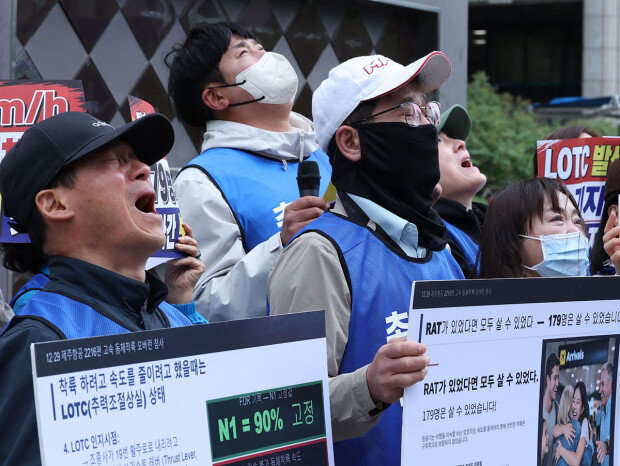
Some bereaved families of the Dec. 29 Jeju Air disaster at Muan International Airport say investigators must determine why the aircraft attempted a belly landing at about 380 kilometers per hour, roughly 1.5 times the normal speed, raising the possibility of a mechanical defect.
About 20 members of a group representing victims’ families, known as the Special Committee for Revising the Law on Systemic Failures and Promoting State Compensation, held a news conference on the 28th outside the Seoul office of Boeing. They said the crash was caused not by the embankment the aircraft struck, but by a possible flaw in the plane.
The group said earlier investigations had centered on the impact involving the Boeing 737 and the embankment, while giving insufficient attention to why the aircraft failed to control its speed. They argued that after a bird strike, the plane may have entered a loss of thrust control condition, in which engine output remains fixed regardless of pilot input.
According to the group, a shift in control mode after the bird strike could have locked engine thrust, preventing the aircraft from slowing and forcing it to approach at a much higher speed. They said the jet was traveling at about 380 kph during the belly landing and about 280 kph when it struck the concrete embankment, leading to the crash.
The families also pointed to the absence of a ram air turbine, or RAT, which they described as a critical backup system that supplies electrical and hydraulic power when engines fail.
Kim Yun-mi, head of the group, cited the 2009 emergency landing on the Hudson River, in which all passengers survived. Referring to the case widely known as the “Miracle on the Hudson,” she said the presence or absence of a RAT contributed to starkly different outcomes, contrasting that incident with the Jeju Air disaster, which killed 179 people.
She called for a comprehensive reinvestigation, including a full review of possible structural or mechanical defects.
Hyeong-Ju Lee peneye09@donga.com






 About Dong-A Ilbo