

Military eases border restrictions on vast areas
Military eases border restrictions on vast areas
Posted June. 18, 2026 08:10,
Updated June. 18, 2026 08:10
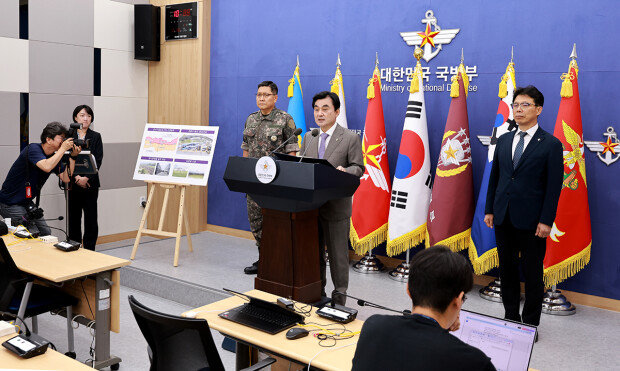
South Korea's military will gradually ease or lift restrictions on military protection zones near the border, opening up an area equivalent to about 240 times the size of Yeouido for development and civilian use.
Defense Minister Ahn Gyu-back announced the plan Wednesday at the Ministry of National Defense in Seoul, calling it a necessary step to reflect changing security conditions while protecting property rights and supporting economic activity in border communities.
● Civilian Control Line to move north
The military will move the Civilian Control Line closer to the Military Demarcation Line, reducing the average distance between the two from about 8 kilometers to 6 kilometers. The line restricts civilian access to areas near the inter-Korean border for security and operational purposes.
The distance varies by region. In western border areas such as Ganghwa and Gimpo, parts of the line are already located just 1 kilometer south of the border. In mountainous areas along the eastern front, including Yanggu and Goseong, it extends as far as 10 kilometers south. The Defense Ministry said the adjustment would ease restrictions on an area roughly 90 times the size of Yeouido by reclassifying it from a controlled protection zone to a restricted protection zone.
Construction is banned in controlled protection zones, while restricted protection zones allow development subject to consultation with the military. Officials said the boundary adjustment will begin next year after security measures, including relocated checkpoints, additional fencing and expanded CCTV coverage, are put in place.
The military also plans to scale back restricted protection zones south of the Military Demarcation Line after reviewing the needs of individual bases and facilities and assessing current operational conditions. Officials estimate that the review could lift restrictions on an area about 150 times the size of Yeouido. Once an area is removed from the restricted category, construction projects will no longer face military approval requirements.
The military said it will begin lifting restrictions in stages from the second half of this year, starting with locations where operational reviews and land surveys have been completed.
The plan also includes the removal of selected anti-tank barriers, roadblocks and other military obstacles in border regions that contribute to traffic congestion or detract from the surrounding landscape. Twenty-three structures identified by local governments and deemed to have outlived their military purpose will be removed first next year.
Military officials said many of the barriers were installed when road networks were limited and were intended to block armored vehicles from using key access routes. With new roads and bypasses now available, many no longer serve the role for which they were built.
● Concerns raised over defense readiness
Some military experts have warned that the changes could make it harder to stop enemy infiltration during peacetime and weaken frontline defenses in a conflict.
Chung Kyung-woon, a senior researcher at the Korea Institute of Military Affairs, said the military is already reducing frontline guard forces because of a shrinking conscription pool. Moving the Civilian Control Line farther north could reduce operational depth near the border and leave troops more vulnerable to North Korean infiltration attempts and other provocations, he said.
Others have also expressed concern that preventing and responding to unauthorized crossings into North Korea could become more difficult.
A Defense Ministry official said the plan was developed after reviewing operational conditions, military planning requirements, public convenience and safety concerns. The ministry will invest in additional fencing, guard posts and other security infrastructure where needed, the official said.
Sang-Ho Yun ysh1005@donga.com








 About Dong-A Ilbo