

Book uncovers secrets of Korean ramyeon
Book uncovers secrets of Korean ramyeon
Posted June. 16, 2026 08:25,
Updated June. 16, 2026 08:25
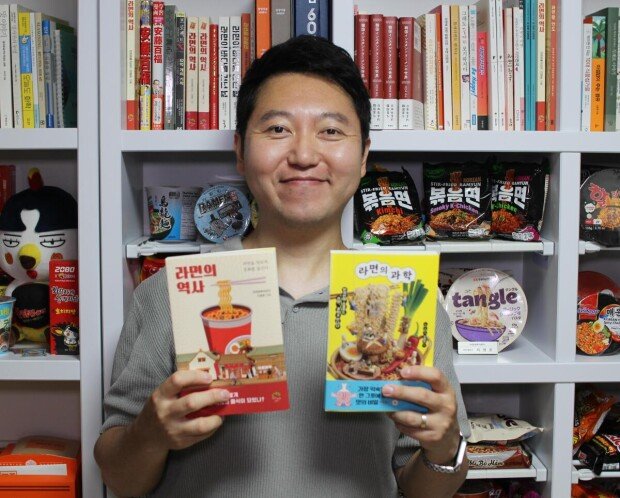
“Instant noodles may seem simple, but they embody some of the most sophisticated science and engineering in modern food manufacturing. Just as South Korea has become a global powerhouse in semiconductors, Korean ramyeon has earned a reputation as the world’s finest instant noodles.”
Few foods are as widely enjoyed by both Koreans and consumers abroad as ramyeon, Korea’s signature instant noodle dish. Ji Yeong-jun, 37, known as a “ramyeon critic,” has published another book devoted to the subject. Speaking by phone with The Dong-A Ilbo on June 8, he said the seasoning powder, dried toppings and noodle block tucked inside a single package represent the culmination of years of research and development.
“Ramyeon is a scientific achievement shaped by relentless efforts to maximize flavor and value,” Ji said. “Its production has been refined through extreme levels of automation and efficiency.”
Ji’s passion for ramyeon began during his military service. After taking South Korea’s college entrance exam four times before enlisting, he found comfort in sampling different brands sold at the base store. In 2013, he began sharing his experiences online under the nickname “Ramyeon Conqueror Piki.” He continued reviewing noodles while working as an elementary school teacher before turning his passion into a full-time career in 2023.
Ji said his fascination stemmed from what he saw as a surprising gap. “Koreans eat more ramyeon than almost anyone else, and Korean brands are regarded as the best in the world,” he said. “Yet few people were introducing or analyzing it in a serious way.”
Over the years, he has tasted and reviewed roughly 2,300 varieties. He pays for every product out of his own pocket and samples 15 to 20 kinds each week.
While Ji’s 2024 book "The History of Ramyeon" traced the development of Korea’s instant noodle industry, his latest work shifts the focus to food science. Based on interviews with food engineering professors, researchers and industry experts, the book explores why noodles are curly and yellow, how seasoning powders are formulated and how dried ingredients are made. To deepen his expertise, Ji recently enrolled in the Department of Food and Nutrition at Korea National Open University.
According to Ji, ramyeon is also one of the most misunderstood foods. “Many people think of it as unhealthy and lacking nutritional value, but it was originally introduced as a nutritious food designed to help address food shortages,” he said.
Citing standards published by the Korean Nutrition Society in 2020, Ji said the balance of carbohydrates, protein and fat in ramyeon is relatively close to ideal. By today’s nutritional standards, however, protein content can be somewhat low. Adding eggs or meat can help round out its nutritional profile, he said.
“There are misconceptions about MSG as well,” he said. “Korean ramyeon contains relatively low levels of sodium for its serving size compared with products in many other countries. MSG is safe when used within approved limits, and it can even help reduce overall sodium levels by allowing manufacturers to use less salt.”
His ambitions extend beyond writing books. Ultimately, Ji hopes to help establish both a ramyeon museum and a university department dedicated to the study of instant noodles.
“Just as universities have departments devoted to semiconductors, ramyeon deserves a place where it can be studied professionally,” he said.
“Once you understand how much expertise, research and ingenuity go into a bowl of ramyeon, you begin to see it in a different light,” he added. “I hope more people discover the pleasure of not only eating ramyeon but also learning how to read and understand it.”
김도연 repokim@donga.com

![[단독]선관위, 결재없이 55억 써도 견책… “솜방망이 징계에 기강 해이”](https://dimg.donga.com/c/138/175/90/1/wps/NEWS/IMAGE/2026/06/19/134138827.4.jpg)




 About Dong-A Ilbo