

Renewable energy push risks outpacing practical constraints
Renewable energy push risks outpacing practical constraints
Posted May. 20, 2026 08:23,
Updated May. 20, 2026 08:23
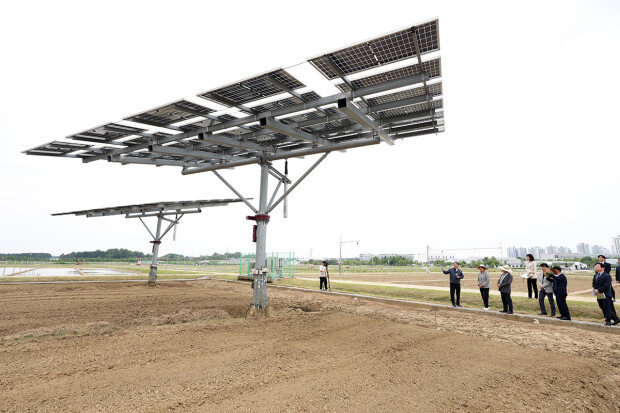
The government on Tuesday unveiled its first comprehensive renewable energy master plan, laying out an ambitious roadmap for South Korea’s energy transition.
The plan formally distinguishes “new energy” sources such as hydrogen and fuel cells from renewable energy, including solar and wind power, marking the first time the categories have been separated in national policy.
Under the roadmap, the government aims to expand renewable energy capacity to 100 gigawatts by 2030, roughly 2.7 times current levels, and raise the share of renewable generation to more than 30% by 2035, up from about 10% today. Officials said the goal is to accelerate deployment and achieve greater economies of scale across the sector.
The strategy calls for the construction of more than 10 large-scale solar complexes, each exceeding 1 gigawatt in capacity, across regions including the Seoul metropolitan area, Chungcheong provinces and Gangwon Province.
Over the next four years, meeting the target would require securing solar installation space equivalent to roughly 24,000 soccer fields. The government also plans to expand deployment on underused land, including factory rooftops, roads, railways and agricultural waterways.
Through competitive bidding and other mechanisms, authorities aim to cut solar generation costs from about 150 won per kilowatt-hour to 80 won by 2035.
Officials said expanding renewable energy has become an unavoidable national priority amid global efforts to reach carbon neutrality, adding that renewables are now seen not as supplemental sources but as core energy infrastructure.
Major technology companies such as Apple and Google are also pushing suppliers to meet RE100 standards, which require 100% renewable electricity use, adding pressure on export-driven economies like South Korea to secure reliable clean energy supplies.
Still, questions remain about the plan’s feasibility. To meet the 2030 target of 100 gigawatts, solar capacity would need to be installed at a pace equivalent to dozens of soccer fields every day. However, the government has not yet released detailed budget estimates.
Uncertainty also remains over how transmission infrastructure will be expanded to carry electricity from generation sites to high-demand regions such as the Seoul metropolitan area. The intermittency of solar power, which fluctuates with weather conditions, adds another layer of complexity.
Some analysts warn that overly aggressive price cuts could deter investment by squeezing profitability in the sector.
Energy policy is widely regarded as a long-term national priority, but critics say it has often shifted with administrations and relied on broad targets rather than detailed execution plans.
Experts say the government will need to ensure the latest roadmap does not remain a paper blueprint, stressing the importance of realistic planning for land use and grid expansion.
They also argue that South Korea should not focus solely on expanding renewables, but instead develop a balanced energy mix that includes nuclear power to ensure both supply stability and progress toward carbon neutrality.





 About Dong-A Ilbo