

Atlas lifts refrigerator as humanoid robot race intensifies
Atlas lifts refrigerator as humanoid robot race intensifies
Posted May. 20, 2026 08:22,
Updated May. 20, 2026 08:22
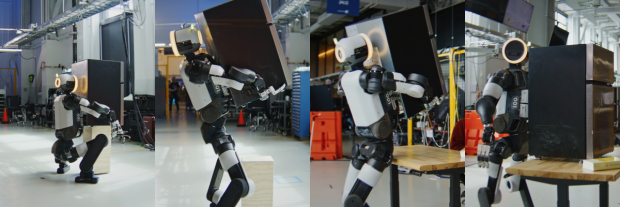
Hyundai Motor Group’s robotics unit Boston Dynamics has released new footage showing its humanoid robot Atlas lifting and carrying a 23-kilogram refrigerator, as the company moves toward planned commercial deployment in 2028.
The demonstration, released alongside a separate clip of Atlas performing gymnastics-style movements, is designed to highlight the robot’s ability to operate in unstructured environments. Together, the videos suggest Atlas is edging closer to real-world industrial applications as competition in humanoid robotics intensifies globally, with companies such as BMW already deploying similar systems on production lines.
● Atlas shows full-body control
In a YouTube video posted May18 (local time) titled “Atlas, can you bring me a drink?”, the robot bends its knees, grips a refrigerator with both arms and lifts it from the floor. It then walks forward while maintaining balance before rotating its upper body to set the appliance down on a table.
Boston Dynamics said the demonstration reflects progress in whole-body control technology.
“The video shows progress in whole-body control,” the company said. “Atlas is moving beyond lab demonstrations and into environments with real-world industrial complexity.”
On the same day, Boston Dynamics also released a video titled “How does Atlas learn?”, outlining its training process. The company said Atlas is trained through large-scale simulation-based reinforcement learning, allowing it to develop and refine behaviors within weeks before transferring them to real-world tasks.
According to the company, the system enables the robot to repeatedly test actions in virtual environments, learning through trial and error to optimize movement. In internal tests, Atlas was also able to lift refrigerators weighing up to 45 kilograms.
Hyundai Motor Group plans to begin mass production of Atlas in 2028 and deploy it on automotive production lines, with broader use in more complex manufacturing processes expected by 2030.
● Global competition accelerates
While Atlas moves toward deployment, rivals are already expanding real-world use of humanoid robots.
BMW said in February it completed a 10-month pilot program using two “Figure 02” humanoid robots from U.S. startup Figure AI at its Spartanburg plant. During the trial, the robots handled more than 90,000 sheet-metal parts and contributed to the production of 30,000 X3 sport utility vehicles.
Building on those results, BMW plans to introduce “Aeon,” a humanoid robot developed by Swedish robotics company Hexagon Robotics, at its Leipzig plant this summer for electric vehicle battery assembly.
Japan has also begun its first airport deployment of humanoid robots. Japan Airlines introduced “G1” robots from Unitree Robotics and “Walker E” robots from UBTech Robotics at Tokyo’s Haneda Airport this month. Under a pilot program running through 2028, the robots will assist with loading cargo containers onto aircraft, with potential expansion into cabin cleaning and other tasks. Bank of America estimates global shipments of humanoid robots will rise to about 90,000 units next year and reach 1.2 million by 2030.
In South Korea, however, experts say adoption has lagged due to the lack of clear safety standards. Park Ji-hoon, an industrial safety specialist at law firm Yulchon, said regulatory gaps could slow deployment. “If safety standards lag, companies will hesitate to adopt the technology,” he said. “Once international standards are established, they need to be quickly adopted domestically so companies can proceed under both global and local requirements.”
최원영 o0@donga.com








 About Dong-A Ilbo