

Lee Jae-myung urges swift supplementary budget passage
Lee Jae-myung urges swift supplementary budget passage
Posted March. 13, 2026 08:31,
Updated March. 13, 2026 08:31
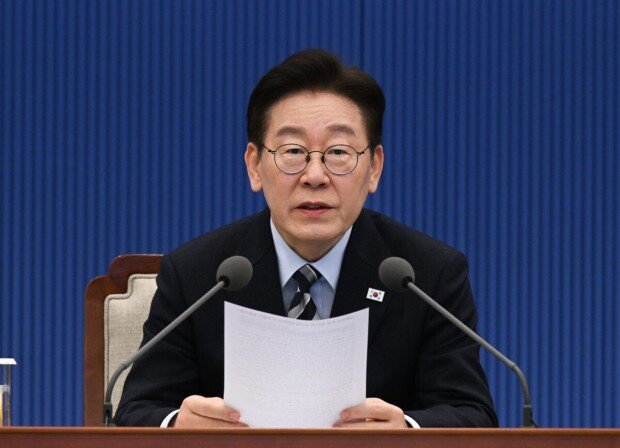
President Lee Jae-myung on Thursday ordered officials to accelerate preparations for a supplementary budget, urging them to move far faster than the usual one- or two-month timeline. He also raised the idea of providing differentiated fuel subsidies through local currency programs in response to the Middle East crisis.
Lee made the remarks during a senior secretaries’ meeting at the presidential office, warning that prolonged instability in the Middle East could weigh on South Korea’s fragile economic recovery. “If the crisis continues, consumer and investment sentiment could weaken, and the recovery we have only recently begun to see could lose momentum,” he said. “Ultimately we may have little choice but to draw up a supplementary budget, so I ask that it be prepared as quickly as possible.”
Lee singled out presidential chief of staff for policy Kim Yong-beom and urged him to press ahead without delay. “Work through the night if necessary. There is no such thing as a weekend right now,” Lee said. “Shorten the timeline as much as possible and design the plan carefully so nothing falls through the cracks.”
Lee said the government should speed up measures including a freeze on public utility fees during the first half of the year and expanded discount programs for agricultural, livestock and fisheries products. He also called for quicker implementation of support such as fuel tax reductions and fuel subsidies for freight truck drivers, public transportation and farmers and fishermen.
He emphasized the need for targeted fiscal support rather than uniform assistance. “If financial aid is distributed across the board, it will be difficult to prevent widening inequality,” Lee said. “Direct and differentiated support should ensure that those facing the greatest hardship receive more help.”
Lee noted that annual tax reductions amount to about 80 trillion won and argued that broad tax cuts or general measures such as fuel tax reductions often fail to produce a noticeable effect. “Support is more effective when the target groups are clearly defined and assistance is delivered in a differentiated way,” he said.
Lee also pushed back against criticism that such measures amount to giveaways or populism. “Some criticize these policies as handouts or populism and try to block them, but such criticism is not desirable,” he said. He added that direct support is preferable and that distributing aid through local currency rather than cash could produce a dual benefit by channeling spending toward small businesses and neighborhood commercial districts.
After Lee stressed the need for speed, the government is expected to consider implementing the supplementary budget earlier than the previously discussed timeline of May. In addition to expanding fuel tax cuts and energy voucher support to offset rising fuel costs, the package is expected to include funding for smart factory programs for small and medium-sized enterprises, measures to address youth unemployment and budget support for the cultural and arts sector.
President Lee also said the Middle East crisis has once again underscored the need to correct unfair or unreasonable practices embedded across society. “As the saying goes, strike while the iron is hot,” he said. “With public demand growing to restore normal standards, this is the moment to accelerate major reforms and deliver tangible results.”
Separately, Lee ordered a thorough investigation into why victims’ remains were left unattended for more than a year in connection with the Dec. 29 Muan Jeju Air disaster, according to the presidential office. The president also called for strict disciplinary action against officials responsible for the incident.
Hoon-Sang Park tigermask@donga.com


![‘무인 공중급유기’ 시험비행 성공…美 “모든 항모에 76대 배치”[청계천 옆 사진관]](https://dimg.donga.com/c/138/175/90/1/wps/NEWS/IMAGE/2026/04/28/133828053.1.jpg)



 About Dong-A Ilbo