

AI robots reshape South Korea factories
AI robots reshape South Korea factories
Posted January. 09, 2026 09:13,
Updated January. 09, 2026 09:13
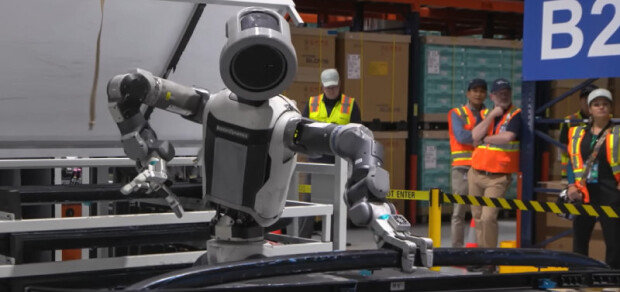
“Robots will make workplaces safer, faster and capable of handling a wider range of tasks.”
Hyundai Motor Group underscored that message on Jan. 5 local time when it unveiled its humanoid robot, Atlas. The group plans to deploy the robot in 2028 at Hyundai Motor Group Metaplant America in the U.S. state of Georgia. The facility already uses Spot, a four-legged robot, to carry out quality inspections alongside human workers. Within two years, the company expects to move toward a next-generation factory in which humanoid and quadruped artificial intelligence robots work alongside people to build vehicles.
When Dong-A Ilbo reporters visited major manufacturing sites across South Korea on Jan. 8, they found that AI-powered robots are already transforming production floors. No longer limited to inspection and monitoring, the machines are increasingly being used in assembly and fabrication processes. South Korea has emerged as one of the global front-runners in the push to commercialize AI robotics.
Domestic shipbuilders have already adopted AI-powered welding robots, boosting productivity by more than 20 percent compared with conventional non-AI systems and more than doubling work speed. Major conglomerates such as Samsung, LG and SK are also using AI in product development and manufacturing, allowing them to virtually produce finished goods and identify potential design flaws or defects in advance.
Abroad, Germany’s BMW Group has introduced AI robots that work alongside human employees in vehicle body assembly and the installation of precision components, increasing work speed by as much as 400 percent. China, meanwhile, has entered the phase of mass-producing humanoid robots comparable to Atlas.
This year is widely seen as the start of an era in which AI robots move to the forefront of global industry. The International Federation of Robotics said the number of AI robots deployed at industrial worksites has doubled over the past decade, even as the sector experienced a downturn during the COVID-19 pandemic. IFR President Takayuki Ito said 2026 will usher in a highly dynamic phase for the robotics industry.
Global market research firm Market.us projects that so-called AI factories, where artificial intelligence and robotics converge, will expand into a $1.0215 trillion market by 2032, equivalent to 1,475.7 trillion won. In its economic growth strategy released last year, the South Korean government said physical AI, including AI robots, is poised to emerge as the world’s leading sector, signaling expectations of even faster growth than in AI software, where the national goal is to rank third globally.
For now, manufacturing sites are dominated by factory-type AI robots equipped with arms or wheels. Looking ahead, however, humanoid robots that resemble humans, such as Atlas, are expected to move through AI-driven factories. Global consulting firm Ernst and Young said that as AI robot technology advances rapidly and prices decline, a cost crossover could occur within five years, making the deployment and operation of AI humanoids cheaper than relying on human labor.
Won-Joo Lee takeoff@donga.com





 About Dong-A Ilbo