

Korea stocks slump as Middle East war spreads
Korea stocks slump as Middle East war spreads
Posted March. 04, 2026 08:47,
Updated March. 04, 2026 08:47
Speculation over a possible World Cup boycott intensified after U.S. and Israeli airstrikes on Feb. 28 reportedly killed senior Iranian officials, including Supreme Leader Ali Khamenei. Spanish outlet Marca reported that Mehdi Taj, president of the Iranian Football Federation, said on state television that it would be difficult to expect Iran to compete in this year’s tournament in the wake of the U.S. strike.
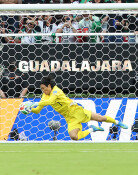
The 2026 World Cup, co-hosted by the United States, Canada and Mexico, is already facing heightened scrutiny amid instability in the Middle East and security concerns in Mexico. Guadalajara, one of the host cities, has drawn particular attention because of violence linked to the country’s crackdown on drug cartels. South Korea, placed in Group A, is set to play two of its three group-stage matches there.
As joint U.S.-Israeli airstrikes on Iran entered a fourth day, U.S. President Donald Trump said Monday that the United States has the capacity to sustain the campaign “far longer than four or five weeks” and did not rule out deploying ground forces. His remarks came as Iran reportedly launched retaliatory actions against 12 countries, including neighboring states in the Middle East as well as British and French military bases. The conflict shows signs of widening and becoming protracted. South Korea must brace for the risk of a compound crisis that could unsettle security on the Korean Peninsula and strain global energy supply chains.
Uncertainty has also grown over a potential North Korea-U.S. summit that Seoul had hoped might gain momentum around Trump’s planned visit to China in late March or early April. While pursuing nuclear negotiations with Iran, Trump authorized a strike that decapitated parts of Iran’s leadership. After witnessing that outcome, North Korean leader Kim Jong Un may further entrench his reliance on nuclear weapons and strengthen alignment with Russia and China. The International Atomic Energy Agency has reported that North Korea appears to have completed a new uranium enrichment-related building at its Yongbyon complex, suggesting it has not paused efforts to expand its nuclear program.
As it did in June last year before striking Iranian nuclear facilities, when it temporarily redeployed part of a Patriot battery stationed in South Korea to the Middle East, the United States could again shift air defense and surveillance assets to counter potential Iranian missile threats. These could include Patriot and Terminal High Altitude Area Defense systems as well as MQ-9 Reaper drones. Although the Patriot unit sent to the Middle East last year returned after four months, a longer conflict this time could prolong any resulting gap in readiness.
Iran, for its part, is pursuing a strategy aimed at maximizing economic disruption, including threats to close the Strait of Hormuz and attacks on regional oil and gas facilities. After drone strikes halted production at some Saudi Arabian refineries and liquefied natural gas facilities in Qatar, global oil and gas prices surged. South Korea’s benchmark Kospi index fell more than 7 percent on Monday. Markets in Asian economies heavily dependent on Middle Eastern energy imports, including South Korea and Japan, experienced sharp volatility.
Market estimates suggest that if the Strait of Hormuz remains closed for one to two weeks, prices for Qatari liquefied natural gas could climb by up to 20 percent. There are effectively no alternative shipping routes for Qatari LNG that bypass the strait. Prolonged supply disruptions could drive up electricity rates and weigh on energy-intensive industries such as semiconductors and steel. South Korea should move preemptively to secure alternative LNG supplies from the United States, South America and Southeast Asia.
Some analysts warn that if the Strait of Hormuz remains shut for several months, international oil prices could approach $100 per barrel and South Korea’s economic growth rate could decline by 0.3 percentage point. Policymakers should prepare on the assumption of a drawn-out conflict and recalibrate strategies for national security and energy stability.

![전국 누비던 허영만도 못 피한 낙상…예방의 핵심은 ‘근육’[노화설계]](https://dimg.donga.com/c/138/175/90/1/wps/NEWS/IMAGE/2026/06/18/134135614.3.jpg)



 About Dong-A Ilbo