

Kospi tumbles 7 percent on Middle East tensions
Kospi tumbles 7 percent on Middle East tensions
Posted March. 04, 2026 08:56,
Updated March. 04, 2026 08:56
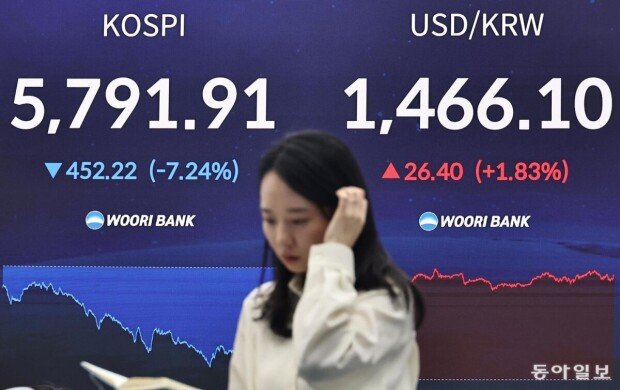
South Korea’s benchmark Kospi plunged more than 7 percent Monday as escalating war risks in the Middle East rattled investors, posting the largest single-day point loss in its history at 452.22 points.
The Kospi 200 Volatility Index, known as the country’s “fear gauge,” jumped more than 16 percent to its highest level in six years, underscoring the abrupt deterioration in market sentiment.
The Kospi closed at 5,791.91, down 7.24 percent from the previous session. It marked the steepest percentage decline since Aug. 5, 2024, when global markets slumped on fears of a U.S. recession and the index slid 8.77 percent. The benchmark has fallen more than 7 percent in a single day only three times in the 2020s.
Heightened geopolitical tensions following U.S. and Israeli airstrikes on Iran weighed heavily on global equities. Although the United States killed Iranian Supreme Leader Ali Khamenei in the early phase of the conflict, anxiety intensified after Iran’s Islamic Revolutionary Guard Corps targeted vessels transiting the Strait of Hormuz, a key corridor for global oil shipments. If the conflict becomes protracted, rising crude prices, accelerating inflation and higher interest rates could compound pressure on risk assets.
Analysts said the sharp sell-off partly reflected pent-up concerns after markets reopened following a one-day closure for the March 1 Independence Movement Day holiday. Regional markets showed similar volatility. Japan’s Nikkei 225 and Hong Kong’s Hang Seng Index initially edged higher before turning lower, while China’s Shanghai Composite Index and Taiwan’s Taiex fell for a second straight session, though their declines were comparatively moderate.
The Kospi’s outsized gains relative to global peers this year also added to investor caution. While major U.S. benchmarks such as the S&P 500 and the Nasdaq Composite have largely moved sideways, the Kospi had surged more than 50 percent, fueling concerns that valuations had run ahead of fundamentals.
The VKOSPI climbed 16.37 percent to 62.98, its highest level since March 19, 2020, when pandemic-driven turbulence pushed it to 69.24.
Foreign investors drove much of the downturn, selling a net 5.1 trillion won worth of shares. They have offloaded a cumulative 19.5 trillion won over the past nine consecutive trading days. Retail investors stepped in as bargain hunters, purchasing a net 5.8 trillion won, while institutional investors sold a net 890 billion won.
The Korean won also came under pressure. Amid a stronger dollar and persistent foreign outflows, the currency closed at 1,466.1 per dollar in Seoul, down 26.4 won from the previous session, marking its largest daily decline this year.
홍석호 will@donga.com

![[단독]사전 투표용지는 실제 선거인수 2배, 2390만명분 준비했다](https://dimg.donga.com/c/138/175/90/1/wps/NEWS/IMAGE/2026/06/23/134165514.1.jpg)





 About Dong-A Ilbo