

Hyundai Motor Group promotes 219 in year-end reshuffle
Hyundai Motor Group promotes 219 in year-end reshuffle
Posted December. 19, 2025 09:50,
Updated December. 19, 2025 09:50
“Secure technological capabilities and future growth engines at the same time.”
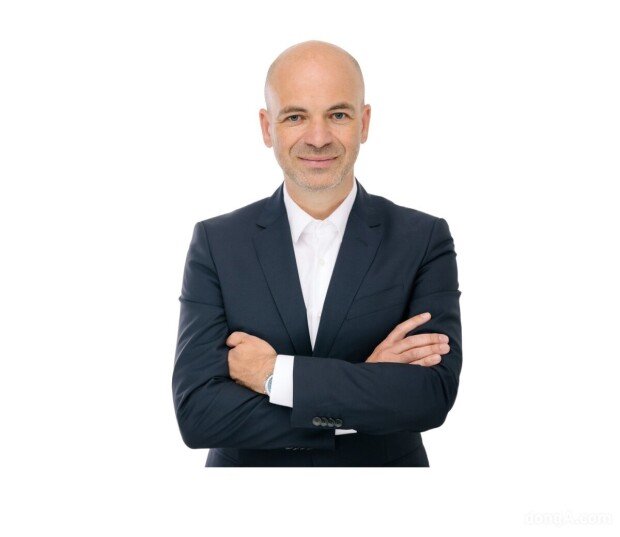
On Dec. 18, Hyundai Motor Group carried out its year-end executive reshuffle for 2025, promoting a total of 219 executives, including Vice President Manfred Harrer to president. The move is seen as an effort to maintain organizational stability while accelerating the company’s shift toward future mobility in a global auto market undergoing rapid change, driven by the rise of Chinese electric vehicles and Tesla’s rapid expansion fueled by full self-driving technology.
Through the reshuffle, Hyundai Motor Group emphasized its transformation from a traditional automaker into a comprehensive mobility company integrating information technology and artificial intelligence. To support this transition, nearly 30 percent of newly promoted executives were assigned to technology and research and development roles.
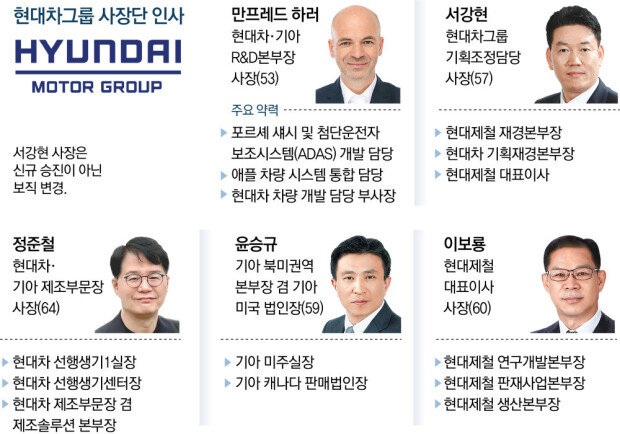
Manfred Harrer, promoted to president, was also named head of Hyundai Motor Group’s research and development division. The company said it expects Harrer to cultivate an organizational culture in which all related areas, including hardware and software, collaborate closely. Harrer is recognized as a specialist in technological convergence, having led both mobility hardware and software operations at Volkswagen Group’s dedicated software unit, as well as at Porsche and Apple.
To further strengthen hardware manufacturing capabilities, Jeong Jun-cheol, vice president and head of the manufacturing division, was also promoted to president, reinforcing the group’s emphasis on enhancing product competitiveness. Hyundai Motor, which views software-defined vehicles as a core future business, signaled its determination to widen the technological gap with competitors in this sector.
In North America, where uncertainty continues to grow, Yoon Seung-gyu, vice president and head of Kia’s North American operations, was promoted to president. His strong performance under challenging conditions, including high tariffs imposed during the second Donald Trump administration, was reported to have been highly valued.
Appointments aimed at boosting synergies across the group were also a central focus of the reshuffle. Seo Gang-hyun, chief executive officer of Hyundai Steel, was transferred to president in charge of group planning and coordination, while Lee Bo-ryong, newly appointed president, succeeded him at Hyundai Steel. Lee, who has extensive experience across R&D and production at Hyundai Steel, is expected to concentrate on strengthening the company’s competitiveness. Seo, widely recognized as a finance specialist with experience across multiple affiliates, assumed responsibility for coordinating operations across the group, taking over from Vice Chairman Jang Jae-hoon.
Hyundai Motor Group also promoted Cho Chang-hyun, chief executive officer of Hyundai Card, and Jeon Si-woo, chief executive officer of Hyundai Commercial, from executive vice president to senior vice president. Shin Yong-seok, a senior vice president recruited externally, was appointed as the second head of the HMG Business Research Institute, the group’s think tank. The reshuffle also reflected a generational shift, with 49 percent of newly promoted managing directors drawn from executives in their 40s.
However, no successor has been named for Song Chang-hyun, the former president and head of the Advanced Vehicle Platform division, who recently stepped down. As Tesla continues to advance its full self-driving technology and Chinese competitors rapidly close the gap, the group appears to be taking additional time to determine the best way to secure its own competitiveness in autonomous driving. An automotive industry official familiar with internal discussions said Hyundai Motor Group has been grappling with how its future platform strategies, including autonomous driving, can better align with its core strength in vehicle manufacturing. The official added that finding a strategy that both differentiates the group from Tesla and leverages its manufacturing expertise may require more time.
Hyundai Motor Group said it will proceed with next-generation development projects aimed at mass-producing core software-defined vehicle technologies established under Song’s leadership. The company added that it will use the latest executive reshuffle as an opportunity for organizational renewal and growth, and will continue investing to secure overwhelming competitiveness in the software-defined vehicle sector.
Won-Joo Lee takeoff@donga.com



 About Dong-A Ilbo