

FIFA raises World Cup prize pool to $655 million
FIFA raises World Cup prize pool to $655 million
Posted December. 19, 2025 09:48,
Updated December. 19, 2025 09:48
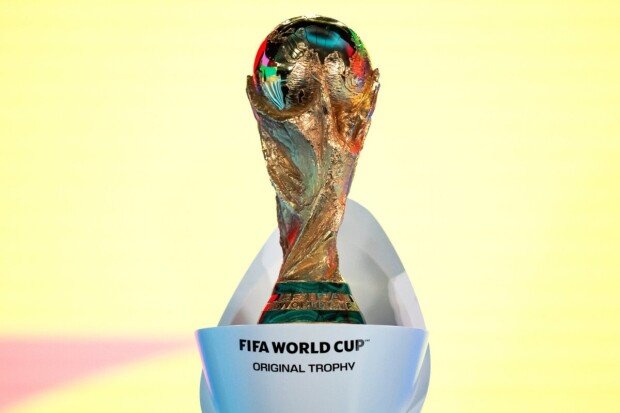
The 2026 World Cup in North and Central America, co-hosted by the United States, Mexico and Canada, is set to become the largest financial spectacle in soccer history.
FIFA said on Dec. 17, local time, that its council meeting in Doha, Qatar, ahead of the Intercontinental Cup final, finalized the tournament’s total prize pool at $655 million, or roughly 968 billion won. The amount represents a 48.9 percent increase over the previous record of $440 million set at the 2022 World Cup in Qatar. FIFA President Gianni Infantino, 55, said the upcoming tournament would mark a milestone in financial distribution across the global soccer community.
FIFA settles its revenues on a four-year cycle tied to each World Cup. The organization expects to generate a total of $13 billion from 2023 through next year, up 71.1 percent from $7.6 billion in the previous cycle. Still, the increase in prize money is smaller than the 50 percent expansion in participating teams, which has grown from 32 to 48. FIFA said the launch of new youth competitions and the provision of recovery funds to regional confederations affected by disputes contributed to the smaller rise.
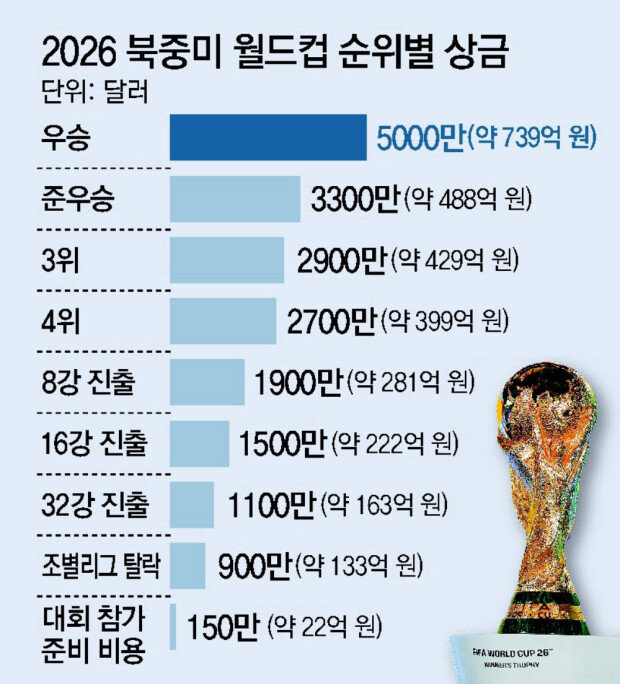
Instead, FIFA took a selective approach to increasing World Cup prize money. The champion of the 2026 tournament will receive $50 million, a 19 percent rise from the $42 million awarded to Argentina, which won the 2022 World Cup in Qatar. The second-largest increase applies to teams reaching the round of 16, whose prize money rises 15.4 percent to $15 million from $13 million.
By contrast, the payout for teams eliminated in the group stage will remain at $9 million. As in the Qatar tournament, FIFA will also provide each participating team with $1.5 million to cover tournament preparation costs. This ensures that every team qualifying for the finals will earn at least $10.5 million, or roughly 15.5 billion won.
If South Korea reaches the quarterfinals, a goal set by national team head coach Hong Myung-bo, the team would return home with $20.5 million in prize money. South Korea has been drawn into Group A alongside Mexico, South Africa, and the winner of European playoff Path D, which includes Denmark, North Macedonia, the Czech Republic, and Ireland. The team will play its opening match on June 12 next year against the European playoff Path D winner at Akron Stadium in Guadalajara, Mexico.
조영우 jero@donga.com







 About Dong-A Ilbo