

Trump highlights coal export gains with Seoul
Trump highlights coal export gains with Seoul
Posted February. 13, 2026 08:14,
Updated February. 13, 2026 08:14
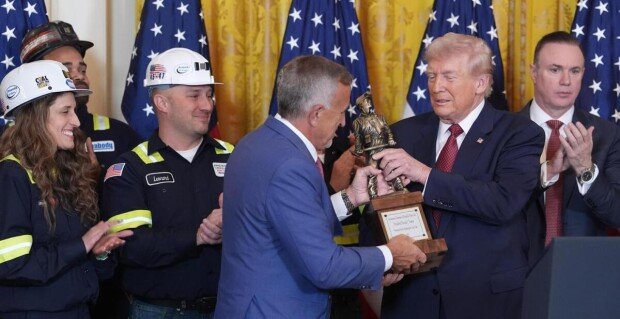
U.S. President Donald Trump said Tuesday that trade agreements concluded last year with South Korea, Japan and India would lead to a substantial increase in U.S. coal exports.
It marked the first time since his return to office in January that Trump has publicly cited coal exports to South Korea. A joint fact sheet issued after Seoul and Washington wrapped up tariff negotiations in October made no mention of coal, and officials familiar with the matter said his latest comments had not been coordinated in advance with the South Korean government.
As the two sides move into consultations over how to carry out South Korea’s investment pledges in the United States, Trump’s pointed reference to coal has fueled speculation that he could push Seoul to boost purchases of American coal significantly. Even before reassuming the presidency, Trump had vowed to revive the fossil fuel industry, dismissing the Biden administration’s renewable energy agenda as a “Green Scam.”
● Coal could feature more prominently in U.S. energy sales
Speaking at a White House event in Washington focused on promoting the coal industry, Trump said the United States had “reached historic trade agreements with South Korea, Japan, India and other countries to dramatically increase coal exports” in recent months. “We are exporting coal all over the world,” he said. “Our coal is the best in the world.”
The comments came as Trump sought to underscore his administration’s efforts to revive the domestic coal sector. His assertion that coal exports to South Korea, Japan and India would expand may have been aimed at highlighting policy accomplishments, irrespective of whether concrete arrangements are currently under negotiation. At a news conference last month marking his first year back in office, Trump also cited an Alaska pipeline initiative intended to ship natural gas to Asian markets. Seoul later clarified that no decision had been made regarding its participation.
The issue of energy purchases has surfaced before. Shortly after Seoul and Washington reached a broad tariff and trade agreement in July last year, Trump wrote on Truth Social that South Korea had agreed to buy $100 billion worth of liquefied natural gas and other energy products. Then-Finance Minister Koo Yun-cheol subsequently said the deal envisioned expanding U.S. energy imports to $100 billion over four years. In that context, analysts say the administration could rely on the existing energy purchase framework to press for greater coal imports. An official at South Korea’s Ministry of Trade, Industry and Energy said Trump’s latest remarks should be viewed against the backdrop of last July’s agreement to increase U.S. energy purchases.
Even so, it remains unclear whether South Korea could substantially raise coal imports from the United States. The country’s overall coal imports have fallen steeply in recent years. Data from the Korea International Trade Association show imports dropping from $28.33 billion in 2022 to $12.51 billion last year, a decline of 55.9 percent over three years. U.S. coal accounts for only about 3 percent to 4 percent of South Korea’s total coal imports.
● Administration broadens support for coal revival
Trump said Tuesday that coal is “a very reliable and inexpensive source of energy,” adding that “more coal means more money in the pockets of American citizens.” He also signed an executive order instructing the Department of Defense to pursue new power purchase agreements with coal-fired plants, signaling a readiness to enlist the military in efforts to shore up the industry.
Separately, the Department of Energy announced $175 million in funding for six coal-fired power plants in Kentucky, North Carolina, Ohio and West Virginia, all states that have long served as Republican strongholds.
The New York Times characterized the moves as a stark turnaround for a coal sector that has contracted significantly in recent years. The newspaper noted that coal generates more air pollution than other energy sources, raising the prospect of renewed environmental concerns.
Jin-Woo Shin niceshin@donga.com


![[단독]주한美사령관 “시진핑, 아침마다 오산-캠프험프리스 가장 먼저 볼것이라 상상해보라”](https://dimg.donga.com/c/138/175/90/1/wps/NEWS/IMAGE/2026/06/01/134028836.1.jpg)




 About Dong-A Ilbo