

Infant with rare heart condition leaves hospital in Korea
Infant with rare heart condition leaves hospital in Korea
Posted December. 18, 2025 08:52,
Updated December. 18, 2025 08:52
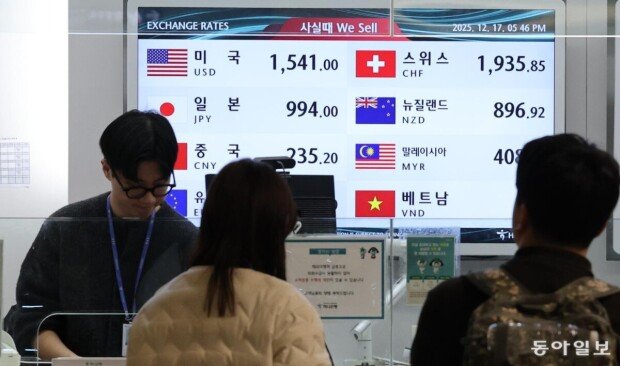
The won-dollar exchange rate climbed into the 1,480 won range during intraday trading. Despite efforts by South Korean foreign exchange authorities to contain the rise, including the creation of a “new framework” with the National Pension Service and calls for cooperation from exporters, the rate reached its highest level in eight months.
On Dec. 17, the won-dollar exchange rate closed regular trading at 1,479.8 won at 3:30 p.m. in the Seoul foreign exchange market, up 2.8 won from the previous session. The currency opened 2.5 won lower at 1,474.5 won but reversed direction after 11 a.m., climbing as high as 1,482.10 won during the session. This was the highest intraday level in about eight months, since April 9, when the rate briefly hit 1,487.6 won amid heightened uncertainty linked to U.S. reciprocal tariffs.
The increase came as foreign investors continued to post net selling in the stock market. On Dec. 16, foreign investors recorded net sales totaling 1.035 trillion won, and they extended the selling trend on the day with additional net sales of 29 billion won.
Upward pressure on the won persisted despite announcements on Nov. 27 that foreign exchange authorities and the National Pension Service would seek to manage elevated exchange rates through a new framework. The pressure also continued despite a decision on Dec. 16 to extend a $65 billion foreign exchange swap agreement between the Bank of Korea and the National Pension Service by one additional year, through the end of next year. Market sources said the swap line was activated on the day as the exchange rate resumed its climb.
Bank of Korea Gov. Rhee Chang-yong addressed the elevated exchange rate at a briefing on the operation of the inflation targeting framework, saying it could be viewed as a crisis but differed from traditional financial crises of the past. He said South Korea is not facing a situation in which it risks sovereign default because it cannot repay external debt due to a weak currency. However, he warned that sharply diverging gains and losses among different groups resulting from a high exchange rate could widen social disparities, adding that further increases could have adverse effects on inflation and economic polarization.
이호 기자 number2@donga.com



![[사설]“尹 계엄 하려 北 도발 유도”… 무지한 건지, 무모한 건지](https://dimg.donga.com/c/138/175/90/1/wps/NEWS/IMAGE/2026/06/12/134104085.1.jpg)




 About Dong-A Ilbo