

U.S. lawmakers urge trade response to Korea digital rules
U.S. lawmakers urge trade response to Korea digital rules
Posted December. 18, 2025 08:51,
Updated December. 18, 2025 08:51
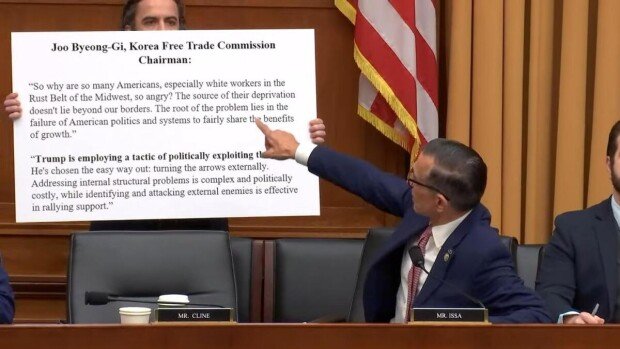
Some members of the U.S. House Judiciary Committee have argued that South Korea’s digital regulations target American big tech companies and that Washington should respond by designating such measures as national security issues and invoking U.S. trade laws. Rep. Darrell Issa of California, a member of the ruling Republican Party, criticized Korea Fair Trade Commission Chairman Ju Byung-ki by holding up a placard quoting the chairman’s past remarks that portrayed the United States in a negative light. Issa used the display to press for the removal of regulations affecting U.S. technology firms.
On Dec. 16 local time, the House in Washington held a hearing titled “How Foreign Governments Target American Companies,” hosted by the antitrust subcommittee of the Judiciary Committee. At the hearing, Subcommittee Chairman Scott Fitzgerald said the European Union’s Digital Markets Act is spreading globally and has appeared in South Korea, as well as in Japan, Brazil and Australia, underscoring the need for a response. His remarks were widely interpreted as reflecting concern that measures similar to the European Union’s recent decision to fine X 120 million euros, or about 208.17 billion won, under the Digital Services Act could emerge in other countries.
In particular, Issa held up a large placard displaying an English translation of key passages from an August opinion column titled “The South Korea-U.S. alliance is not an American service product,” which Ju wrote for a media outlet while he was a professor at Seoul National University and a nominee for chairman of the Fair Trade Commission. The placard highlighted Ju’s assertion that anger felt by white American workers stems from political failure and that U.S. President Donald Trump has been exploiting that anger for political purposes.
Also appearing as a witness at the subcommittee hearing was Shanker Singham, chairman of the Competere Foundation, who has been a vocal critic of non-tariff policies in various countries, including South Korea. Singham claimed that South Korea enforces unpredictable regulations and engages in practices such as harassing witnesses. He argued that such improper policies have imposed costs of $525 billion, or about 787.5 trillion won, on the U.S. economy over the past decade.
Without presenting specific evidence, Singham also asserted that Chinese companies are evading such regulations through ties with South Korean conglomerates. He urged the U.S. government to explicitly designate digital regulations as national security matters and to mobilize Sections 232, 301 and 338 of U.S. trade law, saying such action would send a strong signal to other countries considering regulations on American big tech firms.
Woo-Sun Lim imsun@donga.com







 About Dong-A Ilbo