

Judicial reform exposes tensions between party and presidency
Judicial reform exposes tensions between party and presidency
Posted December. 15, 2025 08:46,
Updated December. 15, 2025 08:46
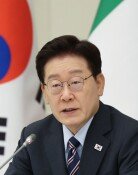
Democratic Party of Korea leader Jung Cheong-rae said on Dec. 11 that at the lawmakers’ general meeting, there was complete agreement among the party, the government and the presidential office, without even a needle’s-eye gap. His comment emphasized that there are no differences between the presidential office and party leadership on judicial reform measures, including legislation to establish a special court for insurrection-related cases. Earlier, on Dec. 9, President Lee Jae-myung held what was described as a surprise dinner meeting with Jung and floor leader Kim Byung-ki. The meeting was reportedly arranged to resolve disagreements that had arisen over judicial reform. Afterward, Lee said, “I hope reform legislation will be handled reasonably and in line with the public’s expectations.”
Jung’s camp interprets the dinner meeting as a show of support for the party. They say it was intended to ease tensions surrounding the so-called “Myung-Cheong showdown,” referring to alleged friction between President Lee and Jung that surfaced after the rejection of the one-person, one-vote system and ahead of a by-election for the party’s Supreme Council. At the center of this explanation is what they call a “division of roles” theory. According to this logic, the National Assembly’s Legislation and Judiciary Committee advances tougher versions of judicial reform bills, such as the special insurrection court legislation, reflecting the voices of hard-line party supporters and boosting their sense of political efficacy. Meanwhile, the presidential office advocates for more reasonable alternatives that address the concerns of moderate voters. In this process, the party leadership absorbs criticism from hard-line supporters, internal elites, and the opposition, reducing resistance and increasing acceptance. The idea is that when hard-liners lead with aggressive demands, subsequent revisions appear more moderate once the presidential office intervenes. Supporters describe this as a form of calculated confusion, often referred to as Jung’s “pacemaker” theory.
For a pacemaker strategy to succeed, however, a shared objective and close coordination are essential. On judicial reform, the presidential office has pointed to communication problems with the party, saying that directions agreed upon in advance are not being properly implemented. The special insurrection court is cited as a case in point. Although senior party and government officials had coordinated to establish the court starting at the appellate level, confusion grew when the Legislation and Judiciary Committee pursued its own course. By raising the possibility of former President Yoon Suk Yeol’s release, the committee tapped into anxieties among hard-line supporters, and the party leadership’s response helped amplify the disorder.
The judicial reform drive led by the party leadership and the committee, with its heavy focus on hard-line supporters, has triggered internal backlash and costly confrontations. At the lawmakers’ meeting on Dec. 8, concerns poured out, including remarks such as, “What does the Democratic Party of Korea gain by getting swept into a vortex of political strife?” The People Power Party demanded the withdrawal of what it labeled the “eight major bad bills,” including the special insurrection court legislation, and launched filibusters against all livelihood-related bills. Its effort to block even routine legislation to stop the special court prompted another controversial step. The National Assembly speaker halted the filibuster by exercising his authority for the first time in 61 years, citing off-agenda remarks.
At this point, it is worth recalculating the costs and benefits of the division of roles. As conflict and confusion intensify, cohesion strengthens among hard-line supporters and among party leaders and committee hard-liners who have echoed their voices. The opposing camp also stands to gain. The People Power Party, which had been mired in internal strife over the Dec. 3 emergency martial law incident, has shifted its focus outward by launching unlimited filibusters and tent sit-ins under the banner of blocking the so-called eight bad bills. As legislative warfare drags on through the end of the year, the burden on the presidential office has grown, with an increased risk of being drawn into partisan confrontation. Ultimately, the biggest losers are the public, who must endure delays in livelihood legislation and a regression into confrontational politics.
Jung’s camp, which champions “party member sovereignty,” has expressed strong displeasure at interpretations that frame discord with the presidential office as his personal political maneuvering. Still, skepticism persists over whether such discord appears less like healthy horizontal checks and balances and more like a power struggle that sacrifices the public’s interests. When a pacemaker puts personal ambition ahead of the race, the race itself is bound to falter.

![[속보]트럼프 “이란과 14일 합의 서명”…혁명수비대 “절대 없을 것”](https://dimg.donga.com/c/138/175/90/1/wps/NEWS/IMAGE/2026/06/14/134105551.1.jpg)



 About Dong-A Ilbo