

Rival candidates propose competing constitutional reforms
Rival candidates propose competing constitutional reforms
Posted May. 19, 2025 07:40,
Updated May. 19, 2025 07:40
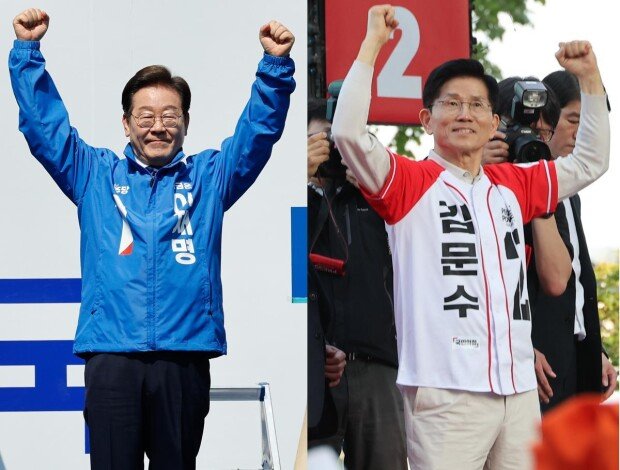
Presidential candidates Lee Jae-myung of the Democratic Party and Kim Moon-soo of the People Power Party unveiled contrasting constitutional reform proposals on May 18. Lee proposed a four-year presidential term with the possibility of two consecutive terms and re-election after a break. Kim countered with a plan to shorten the next president’s term to three years and later introduce a system allowing only one consecutive re-election.
Posting his proposal on Facebook ahead of the May 18 Democratization Movement memorial ceremony, Lee said, “Let’s strengthen presidential accountability while decentralizing power.” He argued that allowing two consecutive terms would enable voters to deliver a midterm judgment on the administration, thereby reinforcing responsibility. His broader reform package includes adopting a presidential runoff system, limiting the president’s veto power, requiring the National Assembly to recommend the prime minister, and making National Assembly approval mandatory for appointing the heads of agencies such as prosecutors’ offices and investigative bodies.
Lee proposed holding a constitutional referendum as early as the 2026 local elections or by the 2028 general elections, after debate in the National Assembly’s special committee on constitutional reform and revisions to the Referendum Act.
Kim proposed a constitutional amendment to reduce the next president’s term to three years and then transition to a four-year term with a single re-election limit. He criticized Lee’s proposal as potentially opening the door to prolonged rule, arguing that under Lee’s plan, a president could serve two terms, step aside for one term, and then return for another two terms.
“In contrast, my proposal limits a president to two consecutive terms at most, with a total cap of eight years in office,” Kim said. Lee responded to reporters by noting that constitutional amendments do not apply retroactively, and thus, the proposed re-election clause would not affect the next president.
Oh-Hyuk Kwon hyuk@donga.com



![매년 30억 쓰며 노화 막던 억만장자, 완치법 없는 자가면역질환 진단 [노화설계]](https://dimg.donga.com/c/138/175/90/1/wps/NEWS/IMAGE/2026/07/07/134249064.3.jpg)
![[오늘의 운세/7월 8일]](https://dimg.donga.com/c/138/175/90/1/wps/NEWS/IMAGE/2026/07/07/134255552.1.jpg)



 About Dong-A Ilbo