

South Korea launches 24-hour currency trading
South Korea launches 24-hour currency trading
Posted July. 07, 2026 08:22,
Updated July. 07, 2026 08:22
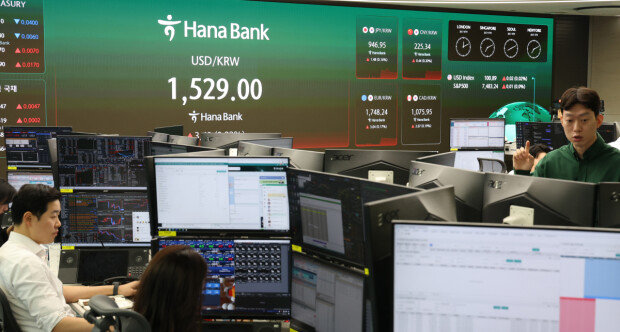
"Ten to sell!" ($10 million sell order.)
"Twenty-eight even. Done!" (Trade executed at 1,528.0 won per dollar.)
Calls from currency dealers filled the trading floor at Hana Infinity Seoul, Hana Bank's foreign exchange dealing room in central Seoul, on Monday morning as South Korea launched nearly round-the-clock currency trading for the first time. Moments earlier, dealers had completed a $10 million transaction, worth about 15.33 billion won, for Samsung Electronics. The electronic board showed the won trading at 1,528.0 per U.S. dollar, up 2.4 won, or 0.16%, from the previous close. By the end of the daytime session at 3:30 p.m., however, the won had weakened to 1,530.3 per dollar, down 4.7 won from the previous trading day as foreign investors extended their selling in the South Korean stock market.
South Korea officially expanded foreign exchange trading hours on Monday, allowing the market to operate almost continuously throughout the business week. The change is expected to help businesses react immediately to overnight currency swings while making it easier for overseas investors to trade the won. Some analysts, however, warn that relatively thin overnight trading could lead to greater exchange rate volatility.
● Businesses welcome faster market access
Until now, won-dollar trading was available from 9 a.m. to 2 a.m. the following day on weekdays. Under the new system, trading runs from 6 a.m. Monday until 6 a.m. Saturday, including public holidays except New Year's Day. In practical terms, the market is now open around the clock on weekdays.
Major currencies, including the U.S. dollar, euro, Japanese yen, British pound and Australian dollar, already trade 24 hours a day across global financial centers.
The extended hours have been welcomed by exporters, importers and overseas bank branches. Joo Min-geun, who oversees foreign exchange trading and currency risk management at Samsung Electronics, said companies previously had to wait until the domestic market opened even when overseas economic data triggered sharp overnight moves in exchange rates. "Now we can respond as events unfold, making currency risk much easier to manage," Joo said.
Lee Sung-pil, head of Hana Bank's London branch, said the longer trading hours would enable the bank to pursue foreign exchange business more actively in overseas markets.
The change is also expected to benefit South Korean retail investors in U.S. stocks, commonly known as "Seohak ants," by allowing them to exchange currency whenever rates are favorable. Parents sending tuition and living expenses to children studying overseas will likewise gain greater flexibility.
● Broader access, but new challenges
The longer trading hours are part of the government's campaign to win South Korea's inclusion in MSCI's developed market index. South Korea is currently part of the MSCI Emerging Markets Index. For years, MSCI has cited limited access to won trading as one of the main reasons for not upgrading the country's market classification. The government believes easier access to the won will strengthen South Korea's bid for inclusion. An upgrade could attract more long-term foreign investment into South Korean equities and help ease pressure on the won-dollar exchange rate.
Market experts say the expanded trading hours should also support the gradual internationalization of the won. At the same time, they argue that South Korea will need to offer a broader range of investment products to draw more overseas investors and further deepen foreign exchange trading.
Some analysts also caution that a market open almost around the clock will respond immediately to political and economic developments overseas that occur overnight, potentially increasing short-term volatility. Kang Hyun-joo, a senior research fellow at the Korea Capital Market Institute, said limited overnight liquidity could temporarily amplify exchange rate movements, leading to sharp spikes in the won-dollar rate.
"It will be important to increase market liquidity and strengthen monitoring to prevent excessive volatility," Kang said.
주현우 기자 woojoo@donga.com



![[오늘의 운세/7월 7일]](https://dimg.donga.com/c/138/175/90/1/wps/NEWS/IMAGE/2026/07/07/134248270.1.jpg)




 About Dong-A Ilbo