

Democrats press ahead on committee control
Democrats press ahead on committee control
Posted July. 01, 2026 08:30,
Updated July. 01, 2026 08:30
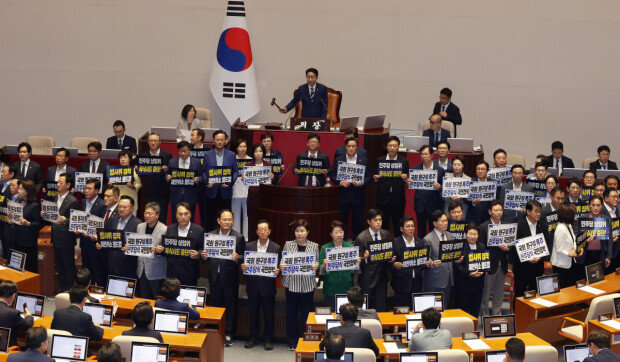
The ruling Democratic Party of Korea pushed through the allocation of standing committee chairmanships for the second half of the 22nd National Assembly on the 30th in a plenary session, after the People Power Party boycotted the vote. The ruling party selected chairs for 11 standing committees, including the influential Legislation and Judiciary Committee, over which the two sides had been locked in a prolonged standoff. It said the remaining seven committees will be assigned later. In the same session, the Democratic Party of Korea also passed the confirmation motion for Prime Minister nominee Han Sung-sook without opposition participation. The People Power Party refused to take part in the vote, protesting the process.
The Democratic Party of Korea argues that standing committees must be launched first in order to move urgent legislation forward. It is true that, one month into the second half of the Assembly’s term, lawmakers had yet to be assigned to committees, leaving the legislature largely idle. However, during the first half of the 22nd National Assembly, when the Democratic Party of Korea also controlled 11 committee chairmanships, legislative output was not particularly strong. The passage rates for bills in committees chaired by the Democratic Party of Korea stood at 7.6%, compared with 6.9% in committees chaired by the People Power Party, with both figures widely seen as underwhelming.
This reflects a broader pattern in which the Democratic Party of Korea has at times sidelined deliberative procedures in committee work to advance contentious legislation, while the People Power Party has also contributed to legislative paralysis by refusing to engage with bills in committees it does not control. The result has been prolonged deadlock in which bills tied to everyday livelihoods have been repeatedly delayed amid procedural confrontations. Ultimately, restoring a consultative process within standing committees is seen as essential to normalizing lawmaking. Instead, the Democratic Party of Korea pressed ahead unilaterally from the outset in dividing committee control, while the People Power Party has struggled to offer a viable path toward compromise.
The confirmation process for Prime Minister nominee Han Sung-sook followed a similar trajectory. The People Power Party opposed the nomination and boycotted committee proceedings from the stage of reviewing the confirmation report. The Democratic Party of Korea, rather than seeking bipartisan agreement, relied on its parliamentary majority to force the vote through. As a result, as with the confirmation of Kim Min-seok last year, the process proceeded without participation from the main opposition party, effectively turning it into a split vote.
This leaves the final two years of the Assembly’s term beginning under a familiar cycle of majority dominance and minority boycott. If the pattern continues, further clashes over key livelihood legislation are likely. The Democratic Party of Korea will need to demonstrate its ability to convert its parliamentary strength into effective governance, while the People Power Party must reestablish itself as a credible policy alternative. An all-or-nothing approach from either side leaves little room for progress.

![[오늘의 운세/7월 5일]](https://dimg.donga.com/c/138/175/90/1/wps/NEWS/IMAGE/2026/07/03/134235104.1.jpg)





 About Dong-A Ilbo