

Fuel shortages hinder Venezuela quake rescue
Fuel shortages hinder Venezuela quake rescue
Posted July. 03, 2026 08:37,
Updated July. 03, 2026 08:37
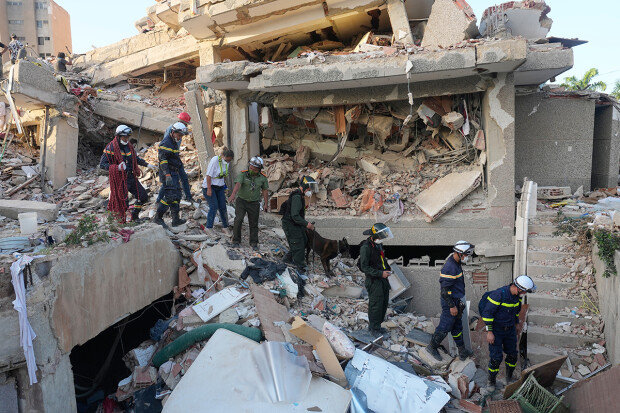
Venezuela's response to the devastating earthquake that struck on June 24 has been crippled by gasoline shortages, leaving excavators and other heavy rescue equipment idle despite the country holding the world's largest proven oil reserves. CNN reported Tuesday that government-owned excavators at rescue sites in the northern state of La Guaira were unable to operate because they had run out of fuel. Rescue crews have instead been digging through collapsed concrete with pickaxes, shovels and even their bare hands. In a separate development, local police arrested four government employees deployed to the disaster zone on suspicion of stealing valuables from the rubble. The incidents have intensified public anger over the government's faltering disaster response.
Venezuela is home to an estimated 303 billion barrels of proven oil reserves, more than any other country. Yet chronic gasoline shortages have become a fact of life because the country's refining capacity remains inadequate and its refineries have struggled to operate reliably. Political analyst Carmen Beatriz Fernández said the disaster was the result of a government that had devoted its energy to repression and propaganda instead of strengthening the state's ability to respond to emergencies. She argued that the leftist populist government has been more focused on preserving its rule than preparing for disasters such as earthquakes.
Oil production and exports once made Venezuela one of South America's richest countries. That prosperity unraveled after former President Hugo Chávez took office in 1999 and continued to erode under President Nicolás Maduro. After nationalizing energy companies, the Maduro government directed oil revenues toward free health care, free education and subsidized housing, placing enormous strain on state finances. Aging infrastructure and U.S. sanctions further weakened the country's oil industry. Between 2013 and 2021, Venezuela's gross domestic product contracted by 75%, and roughly one-quarter of the population left the country.
The New York Times reported that recovering victims, identifying the dead and arranging burials are expected to test authorities already weakened by decades of economic collapse and corruption. Morgues in La Guaira have already run out of space, forcing some bodies to remain in the open despite the intense heat. With DNA testing beyond the financial reach of many families, relatives have had to identify victims through tattoos, dental records and clothing. "So many bodies have decomposed that even their own families can't recognize them anymore," one bereaved relative told CNN.
Jorge Rodríguez, president of Venezuela's National Assembly, said Tuesday that the confirmed death toll had risen to 2,295, while 11,267 people had been injured.
김보라 purple@donga.com

![[단독]韓정부, 하메네이 장례식 불참…“이란측에서 난색 표해”](https://dimg.donga.com/c/138/175/90/1/wps/NEWS/IMAGE/2026/07/05/134237981.1.jpg)

![[단독]삼성전자, 사내 주거대출 ‘국평 85㎡’ 이하로 제한한다](https://dimg.donga.com/c/138/175/90/1/wps/NEWS/IMAGE/2026/07/05/134239674.1.jpg)




 About Dong-A Ilbo