

Presidential office floats nationwide AI dividend
Presidential office floats nationwide AI dividend
Posted May. 13, 2026 08:21,
Updated May. 13, 2026 08:21
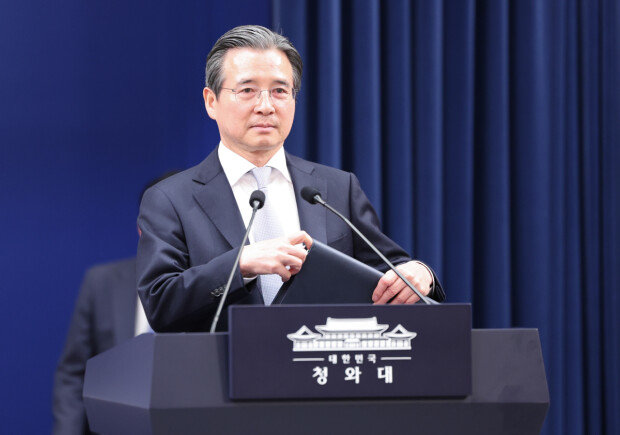
Kim Yong-beom, South Korea’s presidential policy chief, said Tuesday that the wealth generated in the artificial intelligence era should not be concentrated in a small number of companies, arguing that part of the gains should be “structurally returned” to the public.
His remarks come as South Korea braces for a sharp increase in tax revenue driven by a booming semiconductor industry tied to the AI sector, fueling debate over how the government should use the expected windfall.
In a Facebook post, Kim raised what he described as a key challenge of the AI era: how to institutionalize the “structural excess profits” created by AI infrastructure investment. “If AI produces record levels of surplus tax revenue, the issue is not simply whether to spend the money, but how to design a system for using it,” he wrote.
Kim said the current AI boom was built on decades of collective national investment rather than the efforts of individual companies alone. “These gains rest on foundations accumulated by the entire public over the past half century,” he said. “Part of the returns should therefore be systematically shared with the people.”
His comments are expected to sharpen debate within the government as officials prepare next year’s budget following the June 3 local elections. Political observers viewed the remarks as an early proposal for a nationwide “citizen dividend” funded through surplus tax revenue.
Kim pointed to Norway’s sovereign wealth fund as an example, noting that the country used oil profits in the 1990s to build long-term national assets for future generations.
As possible uses for such public funds, he mentioned support for youth entrepreneurship, basic income programs for farming and fishing communities, aid for artists, stronger old-age pensions and education programs designed to help workers adapt to the AI transition.
Financial investment firms estimate that corporate tax payments from Samsung Electronics and SK hynix alone could surpass 100 trillion won in 2027. That would exceed the country’s total corporate tax revenue of 84.6 trillion won collected in 2025.
Some analysts also forecast that South Korea’s economic growth this year could exceed 3 percent, well above earlier projections, as expectations grow that the AI-driven semiconductor boom will continue.
With tax revenue expected to climb sharply alongside gains in semiconductor exports and stock markets, the government is also expected to maintain an expansionary fiscal stance in next year’s budget proposal.
The term “citizen dividend,” however, quickly drew criticism from the opposition People Power Party, with some critics accusing the government of promoting socialism. Kim rejected the criticism, saying the proposal was not meant to impose a new windfall tax on corporate profits. Instead, he said, it was aimed at using the naturally increasing tax revenue generated by the AI industry boom.
윤다빈 empty@donga.com




 About Dong-A Ilbo