

Park Chan-wook reflects on Korean cinema’s rise
Park Chan-wook reflects on Korean cinema’s rise
Posted May. 14, 2026 08:41,
Updated May. 14, 2026 08:41
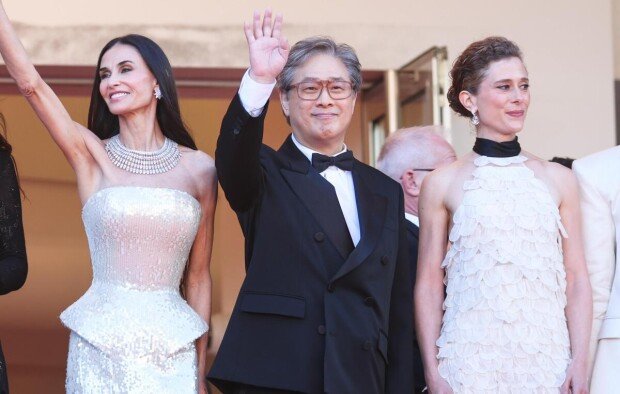
“It’s wonderful to see three Korean films invited to Cannes this year with such strong expectations surrounding them. But that doesn’t mean I’ll be giving Korean films higher marks because I’m the jury president,” Park Chan-wook said with a laugh.
The 79th Cannes Film Festival opened Tuesday in Cannes, southern France, kicking off its 11-day run. Park, the first Korean filmmaker to serve as president of the festival jury, spoke with reporters ahead of the opening ceremony about the transformation of Korean cinema over the past two decades.
“Korea is no longer on the periphery of world cinema,” he said. “An extraordinary amount has changed in just 20 years.”
Park recalled attending Cannes for the first time in 2004 with "Oldboy," when Korean films were still relatively uncommon at the festival.
“At that time, Korean films only appeared occasionally at Cannes,” he said. “Since then, the industry has changed dramatically, and somehow that path has led me to this role as jury president.”
Park said he does not view the rise of Korean cinema as a case of one national industry breaking into an exclusive center. Instead, he argued, the center of world cinema itself has broadened to embrace more countries and a wider range of artistic perspectives.
This year, Na Hong-jin’s "Hope" was selected for the main competition section, while Yeon Sang-ho’s "The Horde" will screen in the Midnight Screenings category. Jung Ju-ri’s "Dora" was invited to Directors’ Fortnight. It marks the first Korean entry in the main competition in four years since Park’s "Decision to Leave."
Asked about his approach to judging, Park said he wants to watch each film with anticipation and an open mind, free from prejudice or fixed assumptions. At the same time, he said he would evaluate the films as a professional with clear artistic standards and a strong understanding of cinema history.
Park also weighed in on escalating global tensions, including the recent conflict involving the United States and Iran, while discussing the relationship between politics and art. “It feels odd to treat politics and art as if they stand in opposition to one another,” he said. “A work should not be regarded as hostile to art simply because it contains a political argument. If those ideas are expressed artistically and convincingly, they are worth listening to.”
Park previously served on the competition jury at the 70th Cannes Film Festival in 2017. Reflecting on the moment he was asked to chair this year’s jury, he joked that he spent about five minutes debating the offer because he already understood how stressful the position could be. “But looking back, Cannes has given me so many gifts over the years,” he said. “Eventually, I came to feel that perhaps it was time for me to give something back.”
김태언기자 beborn@donga.com





 About Dong-A Ilbo