

Constitutional reform drive collapses amid filibuster standoff
Constitutional reform drive collapses amid filibuster standoff
Posted May. 09, 2026 07:38,
Updated May. 09, 2026 07:38
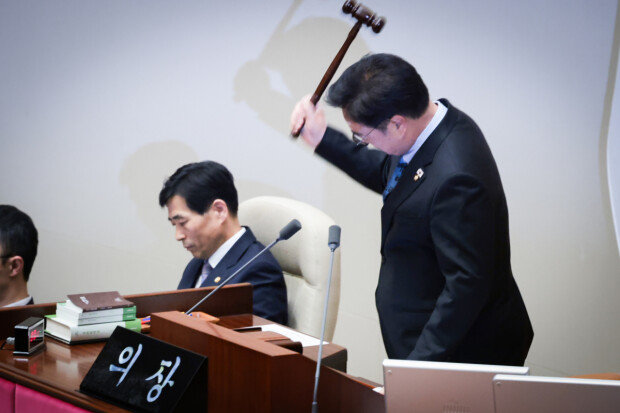
South Korea’s push for constitutional reform collapsed Friday, ending the country’s first major attempt to revise the Constitution since democratization in 1987. National Assembly Speaker Woo Won-shik dropped plans to resubmit the amendment bill after the opposition People Power Party threatened a filibuster.
Woo lashed out at the party after the proposed amendment, which sought to strengthen parliamentary oversight of martial law declarations, failed to return to the Assembly floor.
“The People Power Party will be remembered as a sinner in history,” Woo said.
The People Power Party countered that history would instead judge what it described as an attempt to push through unilateral constitutional revisions with authoritarian overtones.
At the opening of a plenary session Thursday, Woo said he had reconvened the Assembly in a last effort to keep the constitutional revision drive alive.
“But after seeing the response come back in the form of a filibuster, I no longer believed further proceedings would serve any purpose,” he said.
Woo later announced he would not formally reintroduce the amendment bill, effectively halting procedures needed to hold a national referendum on June 3. He had initially planned to continue pursuing passage of the amendment until May 10, the deadline for placing the proposal on the ballot alongside the June 3 local elections. But after the opposition party filed filibuster motions against both the constitutional amendment and 50 livelihood-related bills, Woo abandoned plans to bring the measure back to the floor. He adjourned the session without introducing any legislation.
The amendment proposal, jointly introduced by Woo and six parliamentary parties excluding the People Power Party, was put to a vote during Thursday’s plenary session. However, all 106 lawmakers from the People Power Party boycotted the vote, leaving the Assembly short of the quorum required for a valid ballot.
Under South Korean law, at least two-thirds of sitting lawmakers must participate in a constitutional amendment vote. With 286 lawmakers currently serving in the Assembly, at least 191 votes were needed.
Song Eon-seog, floor leader of the People Power Party, defended the boycott, arguing that the amendment had effectively already been rejected. “More than half of all lawmakers attended Wednesday’s plenary session, satisfying the general quorum requirement,” Song said. “Reintroducing a bill that has already been voted down during the same session violates the principle barring reconsideration of the same matter, leaving us no choice but to respond with a filibuster.”
The National Assembly speaker’s office disputed that interpretation, saying a vote that fails to meet the required quorum is legally considered invalid rather than rejected, citing guidance from the Assembly’s legislative affairs office.
Kang Yoo-jung, spokesperson for the presidential office, said the public would struggle to understand why the opposition blocked what she described as a minimal constitutional revision needed to safeguard democracy and national security. “The constitutional reform discussions promised to the public must continue,” she said.
이상헌 dapaper@donga.com

![[단독]사전 투표용지는 실제 선거인수 2배, 2390만명분 준비했다](https://dimg.donga.com/c/138/175/90/1/wps/NEWS/IMAGE/2026/06/23/134165514.1.jpg)


![금태섭 “李정부 지탱한 ‘내란 프레임’ 이제 깨졌다”[황형준의 법정모독]](https://dimg.donga.com/c/138/175/90/1/wps/NEWS/IMAGE/2026/06/23/134167619.1.jpg)


 About Dong-A Ilbo