

Costly local projects drive losses nationwide
Costly local projects drive losses nationwide
Posted April. 20, 2026 08:40,
Updated April. 20, 2026 08:40
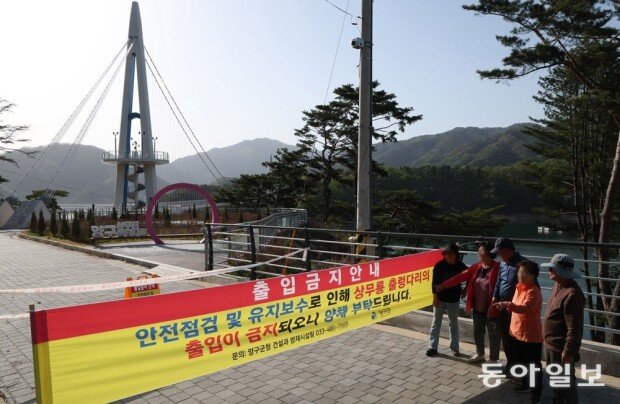
The Sangmuryong suspension bridge in Yanggu County, Gangwon Province, opened in 2022 at a cost of 13 billion won, including 7.8 billion won in national funding and 5.2 billion won from the county government. The project was intended to boost tourism and provide access for about 40 residents of a village cut off by dam construction, who rely on boats for transportation.
Residents, however, still travel by boat. Most are elderly, and carrying loads across the long bridge is difficult. The boat route is also quicker. Since mid-March, the bridge has been closed over safety concerns, turning away tourists as well. There is no timeline for reopening.
Local government leaders have increasingly pledged to build suspension bridges in the name of tourism promotion. The number nationwide has climbed from 110 in 2010 to 259 last year. Yet the Korea Culture and Tourism Institute found that their ability to attract visitors peaks within the first year after completion, then declines and effectively disappears after seven years.
An analysis released on April 19 by The Dong-A Ilbo found that public facilities built by local governments are generating nearly 1 trillion won in annual losses. The review covered 532 facilities, each built at a cost of more than 10 billion won.
Concerns are growing that losses could widen if campaign pledges lacking rigorous demand forecasts are carried out. Ahead of the June 3 local elections, at least nine regions have proposed dome stadium projects, each expected to cost hundreds of billions of won.
According to the Ministry of the Interior and Safety, annual losses from public facilities such as sports stadiums, cultural centers and tourist attractions have risen steadily, from 700.6 billion won in 2022 to 728 billion won in 2023 and 948.3 billion won in 2024. Because the ministry discloses data only for facilities costing at least 20 billion won for metropolitan governments and 10 billion won for basic municipalities, the actual scale of losses is likely higher.
Of the 532 large-scale facilities surveyed, 464, or 87.2 percent, were operating at a loss. Excluding facilities where revenue could not be calculated due to remodeling and other factors, only 63, or 11.8 percent, posted a surplus.
Experts say thorough feasibility studies, including demand forecasts, are essential before projects move forward. While facilities such as libraries and museums are built for public welfare regardless of profitability, large-scale projects funded with substantial budgets require careful estimates of potential losses.
Kim Woo-cheol, a professor of tax studies at Seoul National University, said some local projects are exempt from feasibility reviews due to limited oversight by local councils. He warned that local government heads may push ahead with ambitious construction plans to win elections or boost popularity, underscoring the need for stronger checks and balances.
송은범 기자 seb1119@donga.com

![팔순 노인 전세금까지 빨아먹은 ‘악마의 통장’[히어로콘텐츠/히든①-上]](https://dimg.donga.com/c/138/175/90/1/wps/NEWS/IMAGE/2026/06/22/134153615.1.jpg)
![“1000만원 줄 테니 나가달라”…집주인 제안, 받아도 될까 [집과법]](https://dimg.donga.com/c/138/175/90/1/wps/NEWS/IMAGE/2026/06/19/134130634.3.jpg)

![‘월급 50만원, 아파트는 4억’ 베트남…청년들 “그냥 평생 월세 살란다”[딥다이브]](https://dimg.donga.com/c/138/175/90/1/wps/NEWS/IMAGE/2026/06/19/134141662.1.png)


 About Dong-A Ilbo