

Korean fashion, beauty brands grow in Japan
Korean fashion, beauty brands grow in Japan
Posted April. 22, 2026 09:01,
Updated April. 22, 2026 09:01
“I came after seeing the pop-up on social media. It is a rare chance to try on Korean brands I have been eyeing,” said Ishiyama Aya, 28, as she browsed displays at a Musinsa pop-up store in Tokyo’s Shibuya district on April 16.
The three-story venue drew long lines even on a weekday morning, with visitors ranging from millennials and Gen Z consumers to people in their 60s. Nishimura Nanako, 60, said her interest grew from Korean dramas and K-pop, which led her to explore Korean culture more broadly. A Musinsa official said the store draws more than 5,000 visitors a day on weekends and is often packed despite requiring advance reservations. Since opening on April 10, it has attracted about 45,000 visitors through April 19.
K-beauty and fashion brands are accelerating their push into Japan, leaning on what industry players call “pop-up DNA.” Rather than focusing solely on sales, brands are emphasizing immersive experiences that allow consumers to try on, test and engage with products, helping to quickly expand their reach.
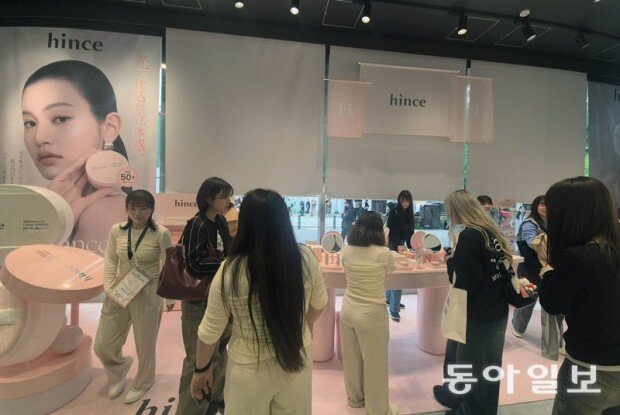
Interest in Korean brands was evident across Tokyo. At @cosme TOKYO in Harajuku on April 15, one of Japan’s largest beauty retail platforms, a prominent pop-up for LG H&H’s Hince drew steady crowds. Shoppers tested lip and cushion products to compare shades and bought items on the spot. A store employee said demand for hands-on K-beauty experiences has risen noticeably. Products from Gudai Global’s TirTir, Beauty of Joseon and Amorepacific’s Aestura were ranked among the top three in their respective categories.
Earlier, Korean multi-channel network firm Leferi partnered with Amazon to host a K-beauty select shop in Omotesando, an upscale Tokyo district known for luxury brands. The event featured products from 11 brands, including Shinsegae International’s Vidivici. More than 1,000 Korean and Japanese creators took part, producing review content that spread across social media.
The surge in pop-up launches reflects a strategy tailored to local consumer preferences and Japan’s retail structure, where offline shopping still dominates. According to Japan’s Ministry of Economy, Trade and Industry, the business-to-consumer e-commerce penetration rate stood at 9.8 percent in 2024. Japanese consumers tend to prefer seeing, touching and trying products before making a purchase.
Shifting consumption patterns are also shaping the trend. Spending is moving away from ownership-driven consumption toward experience-focused consumption. In that environment, pop-up stores have emerged as an effective way to communicate a brand in a short time. The approach is particularly well suited to fashion and beauty, where in-person experience plays a key role.
Park Yong-min, head of KOTRA’s Japan regional headquarters, said a model built on K-content and experiential marketing such as pop-ups is becoming a proven formula for turning interest into purchases in the Japanese market.
도쿄=남혜정 namduck2@donga.com







 About Dong-A Ilbo