

Seoul secures UAE crude amid Iran crisis
Seoul secures UAE crude amid Iran crisis
Posted March. 19, 2026 08:39,
Updated March. 19, 2026 08:39
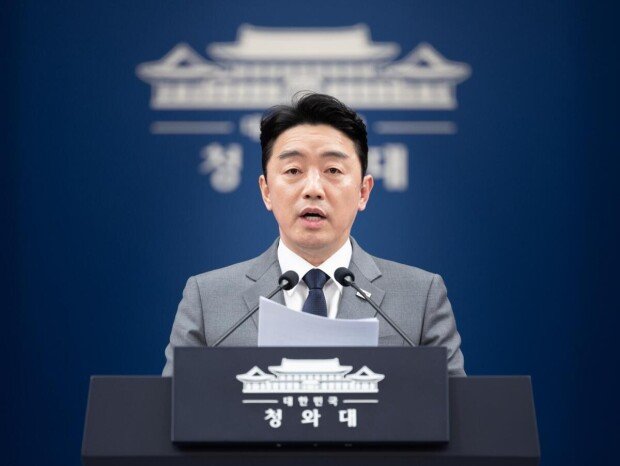
The South Korean government has decided to import an additional 18 million barrels of crude oil from the United Arab Emirates to ease energy supply uncertainty stemming from a prolonged conflict between the United States and Iran. Combined with a previously secured 6 million barrels, the country will hold a total of 24 million barrels, roughly eight times its daily oil consumption of about 2.8 million barrels.
Kang Hoon-sik, presidential secretary, briefed reporters at the Blue House on March 18 after returning from the UAE. “We have finalized the emergency import of a total of 18 million barrels of crude oil from the UAE," Kang said. "Three UAE-flagged vessels will deliver 6 million barrels, and six South Korea-flagged vessels will supply 12 million barrels.” Kang traveled to the UAE late on March 15 as a special presidential envoy for strategic economic cooperation and returned on March 18. He had previously announced on March 6 that South Korea had reached an agreement to import more than 6 million barrels of crude from the UAE.
Kang added that the UAE had assured South Korea, saying, “No country will receive crude oil before South Korea. South Korea is the top priority for oil supply.”
The Blue House expects the agreement with the UAE to play a major role in stabilizing the country’s oil supply. In response to the prolonged Middle East tensions, the government raised its resource security alert for crude oil from “interest” to “caution” at 3 p.m. on March 18. Kang stressed, “The worst-case scenario in oil supply has been avoided. At least there will be no situation in which crude oil cannot reach South Korea.”
South Korea and the UAE also agreed to sign a memorandum of understanding on oil supply chain cooperation, including exploring alternative routes to the Strait of Hormuz.
Amid Iran’s blockade of the Strait of Hormuz, which has disrupted global oil shipments and sparked competition for crude, the UAE deal is seen as a product of strengthened bilateral ties. Previously, the UAE facilitated the return of 3,000 South Korean short-term residents. Facing Iranian missile attacks, the UAE has also requested the rapid delivery of South Korea’s domestically produced Cheongung-2 surface-to-air missile systems.
Kang noted that a vessel carrying naphtha, a key raw material for petrochemical products now in short supply due to Middle East tensions, is also on its way to South Korea. Because 54% of the country’s naphtha imports pass through the Strait of Hormuz, the government designated naphtha as a temporary economic security item on March 18. This allows authorities to manage supply through export controls, stockpiling and diversification of import sources.
Kyu-Jin Shin newjin@donga.com

![스쿼트 개수는 ‘하체 나이’ 지표… 연령별 기준 몇 개?[노화설계]](https://dimg.donga.com/c/138/175/90/1/wps/NEWS/IMAGE/2026/05/08/133884776.3.jpg)





 About Dong-A Ilbo