

Gyeongju showcases AI, XR, autonomous shuttles at APEC
Gyeongju showcases AI, XR, autonomous shuttles at APEC
Posted October. 29, 2025 08:15,
Updated October. 29, 2025 08:15
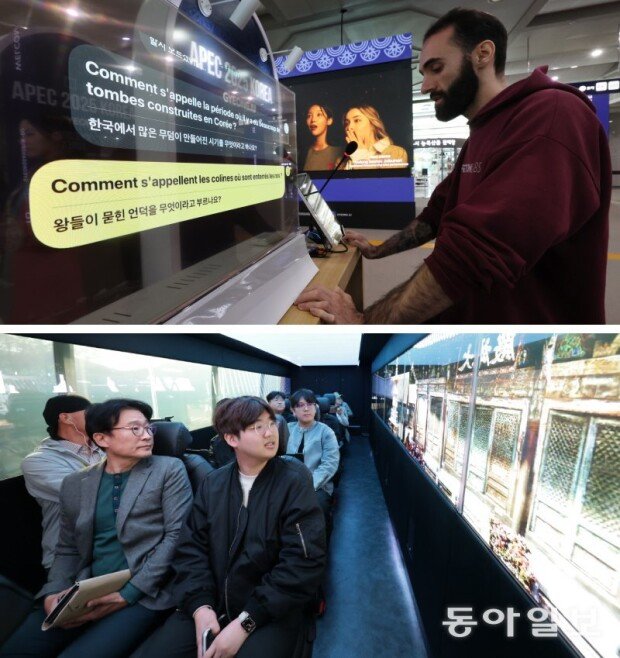
Around 2 p.m. on Oct. 28, a foreign traveler with a large backpack stood at the information desk in the KTX Gyeongju Station waiting hall in Geoncheon-eup. He selected Chinese on a tablet, tapped the microphone icon and spoke. A Korean translation quickly appeared on the monitor. The device was an interactive AI interpretation and translation system offering real-time translation for all 21 APEC member languages. When a staffer replied in Korean that he could take a city bus, the response appeared in Chinese. The traveler smiled and gave a thumbs-up.
The thousand-year-old city of Gyeongju has received a technological facelift ahead of the APEC summit. AI translation, autonomous buses and extended reality tourism have been introduced throughout the city, blending ancient heritage with modern technology.
The AI translation units were installed to help delegates and foreign tourists quickly access information on venues, transportation, restaurants and sightseeing. They are located at Gyeongju Station, Gimhae International Airport, downtown restaurants and hotels, and the Gyeongju HICO convention center. One-on-one interpretation devices have also been distributed to major hotels.
A Gyeongju resident said the 21-language translation system has made it much easier for foreigners to ask for directions and obtain information, adding that he hopes the devices will remain in place after the summit.
Around the Bomun Tourism Complex, an eight-passenger autonomous minibus called ROii is operating. It has no driver’s seat and uses level 4 self-driving technology. Four lidar sensors and seven cameras provide 360-degree awareness as the shuttle travels between Gyeongju Expo Park, HICO, and official hotels. It automatically slows when other vehicles merge, ensuring stable operation. A member of the APEC summit support team said four ROii vehicles and one 20-passenger autonomous bus were deployed to showcase Korea’s future mobility technology.
Gyeongju is also operating an extended reality tourism bus that recreates the Silla capital from about 1,400 years ago. Window panes switch from transparent glass to XR screens that display scenes of Hwangnyongsa Temple, the Cheomseongdae observatory and Wolseong as they would have appeared in Silla’s heyday. The service runs for summit participants through Nov. 2 and opens to the public Nov. 5.
At Cheomseongdae, a nighttime media art program called “Moonlight of Silla” is underway. The observatory’s outer wall serves as a projection screen, showcasing Silla astronomy and constellations. The program starts with scenes of ancient astronomers observing the sky, followed by imagery of the Milky Way, meteor showers and comets. It then displays 1,467 stars, 28 constellations and the four guardian symbols: the blue dragon, white tiger, red bird and black tortoise. The projection lasts about seven minutes. Gyeongju city officials are considering keeping the program as a permanent nighttime attraction after APEC.
경주=김화영기자 run@donga.com





 About Dong-A Ilbo