

Court rejects Yoon’s martial law claim
Court rejects Yoon’s martial law claim
Posted February. 21, 2026 08:47,
Updated February. 21, 2026 08:47
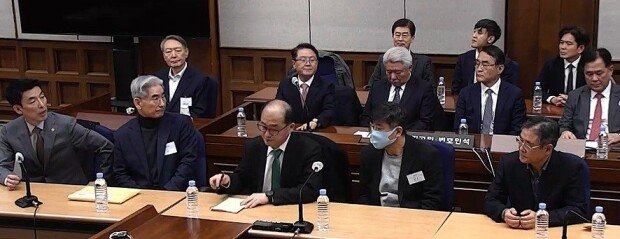
A court has dismissed former President Yoon Suk-yeol’s contention that his Dec. 3 declaration of emergency martial law was merely a “warning measure” intended to alert the public to what he called legislative overreach by the opposition Democratic Party of Korea. In its ruling, the court stated unequivocally that the notion of “warning martial law” has no basis in law. It also deemed credible testimony from senior military officials that Yoon instructed commanders to “break down the National Assembly doors, even by firing guns if necessary, and drag out the personnel,” rejecting most of the former president’s defenses.
According to the 1,234-page first-instance decision in the insurrection case against Yoon and his co-defendants, Criminal Division 25 of the Seoul Central District Court, presided over by Judge Ji Gui-yeon, found that neither “warning martial law” nor “appeal-type martial law” is legally sustainable. The court held that emergency martial law, by definition, involves the use of military force to address a grave national emergency. It cannot be reduced to a symbolic or precautionary gesture and, once proclaimed, inevitably produces far-reaching effects on citizens’ rights and duties. The panel underscored that such authority may be exercised only to restore public order in response to a genuine and serious breakdown. By that measure, it concluded, the Dec. 3 declaration did not satisfy the legal threshold.
The court also accepted most of the prosecution’s accounts from senior military commanders that had been disputed during impeachment proceedings before the Constitutional Court. It found that Yoon instructed then–Capital Defense Command chief Lee Jin-woo to press ahead with operations even if a motion to lift martial law were passed, suggesting he could declare it a second or even third time. The panel further determined that Yoon ordered then–Army Special Warfare Command chief Kwak Jong-geun to “quickly break down the doors of the National Assembly and drag out the personnel inside,” concluding that the term “personnel” referred to lawmakers. That conclusion directly contradicts Yoon’s earlier assertion at the Constitutional Court that he never used the expression and that related testimony had been fabricated to secure his impeachment.
The panel also dismissed Yoon’s contention that an insurrection cannot be carried out with unloaded weapons. Referring to the entry of advance agents from the Defense Intelligence Command into the Gwacheon complex of the National Election Commission while carrying unloaded firearms on the night martial law was declared, the court said the presence of 10 armed soldiers entering a government building late at night would be enough to instill fear in an ordinary person. Those confronted, it noted, could not be expected to know whether the weapons were loaded. The absence of ammunition, the panel added, does not negate the legal elements of assault or intimidation.
The court also found Yoon’s assertion that troops were dispatched to the National Assembly and other sites solely to maintain order to be internally inconsistent. Even by his own account, the panel noted, the primary mission assigned to Capital Defense Command forces was to secure control of the National Assembly. That characterization, the court observed, indicates that the deployment was aimed at exerting control over the legislature, effectively implying an intent to suppress it.
송유근 big@donga.com


![[속보]전한길 구속영장 기각…法 “증거인멸-도망 염려 없어”](https://dimg.donga.com/c/138/175/90/1/wps/NEWS/IMAGE/2026/04/16/133757150.1.jpg)





 About Dong-A Ilbo