

North Korea moves to codify two-state doctrine
North Korea moves to codify two-state doctrine
Posted February. 21, 2026 08:47,
Updated February. 21, 2026 08:47
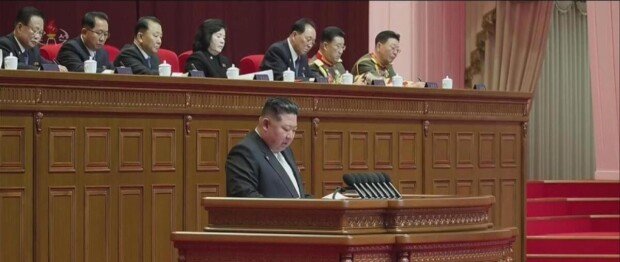
North Korea opened the Ninth Congress of the Workers’ Party of Korea in Pyongyang on Feb. 19, launching the country’s most consequential political gathering, which will set its five-year economic blueprint, shape national defense and foreign policy priorities, and determine key party and state leadership appointments. North Korean leader Kim Jong Un declared that the nation had irreversibly consolidated its external standing, asserting that it had firmly entrenched its status as a nuclear-armed state. A newly released roster of party executive members revealed a sweeping personnel overhaul: Kim Yong Chol, a senior adviser in the party’s United Front Department who previously handled inter-Korean affairs, was dropped, while veteran diplomat and Foreign Minister Choe Son Hui was newly elevated. Analysts say the congress could formally codify Pyongyang’s “two hostile states” doctrine and further harden its posture toward South Korea.
According to the Korean Central News Agency on Feb. 20, Kim said in his opening address that the country had irreversibly consolidated its national standing, bringing about significant shifts in the global political landscape and its external environment. Although he stopped short of explicitly highlighting nuclear and missile development achievements, as he did at the Eighth Party Congress five years ago, his remarks were widely seen as reaffirming Pyongyang’s position that denuclearization is no longer under consideration and that its status as a nuclear-armed state is firmly entrenched. Observers said the comments appeared designed to underscore what North Korea views as growing external recognition, particularly from China and Russia, pointing to Kim’s attendance at China’s 80th anniversary Victory Day military parade last year.
Kim also acknowledged the hardships that followed the Eighth Party Congress, including the COVID-19 pandemic and continued sanctions, but insisted that “everything has fundamentally changed” over the past five years. He claimed the country had secured “epoch-making successes” across politics, the economy, national defense, culture and diplomacy, and said it was entering the Ninth Congress with confidence and optimism about the future. In contrast to the Eighth Congress, where he conceded policy shortcomings, Kim projected self-assurance this time, citing strengthened ties with Russia, including Pyongyang’s decision to send troops to support Moscow in the war in Ukraine.
The congress, which is expected to run for several days, is likely to clarify the trajectory of North Korea’s nuclear and missile programs and lay out its military and diplomatic strategy for the next five years. Close attention is also being paid to whether amendments to party rules could elevate Kim’s title to president, a move that would further consolidate his authority. Since the second half of 2024, state media have increasingly referred to Kim as “head of state” rather than by his formal titles, and the constitution designates the president as the head of state, fueling speculation that legal groundwork may be laid for him to formally assume that position.
Another pivotal issue is whether the “two hostile states” doctrine will be written into party rules. Since late 2023, Kim has defined inter-Korean relations not as an internal national question but as ties between two hostile states. Formalizing that stance would represent a decisive step toward institutionalizing a harder line against Seoul. In that light, the sidelining of Kim Yong Chol, long linked to inter-Korean engagement, alongside the elevation of Choe Son Hui, may signal more than a routine leadership reshuffle. It could point to a broader strategic recalibration in Pyongyang’s approach to South Korea.
Such a shift could pose an early test for the North Korea policy of President Lee Jae-myung’s administration, which has recently signaled a more conciliatory approach. That shift has included Unification Minister Chung Dong-young’s expression of regret over a recent drone incident.
Jang Yoon-jeong, deputy spokesperson for South Korea’s Unification Ministry, said at a regular briefing at 10 a.m. on Feb. 20 that Kim’s opening address contained no specific messages directed at South Korea or the wider international community. Although officials long associated with inter-Korean affairs appeared absent from the new executive lineup, she said, the ministry would refrain from offering a detailed assessment.
Attention is also centered on whether Kim’s daughter, Ju Ae, widely viewed as a key figure in the so-called Mount Paektu bloodline succession, will appear at the congress or related events in the coming days, potentially lending formal weight to a succession narrative. Some observers have speculated that she could receive an official title, such as membership in the party’s Central Committee. She did not, however, appear in photographs or footage released from the opening session. Kim’s sister, Kim Yo Jong, vice department director of the party, was again included in the executive body and seated on the presidium, prompting scrutiny over any possible shift in her rank or influence.
Separately, indications have surfaced that North Korea may be preparing a large-scale military parade in conjunction with the congress. Rep. Yoo Yong-won of the People Power Party, a member of the National Assembly’s Defense Committee, said analysis of satellite imagery taken between Feb. 9 and Feb. 17 at Pyongyang’s Mirim Airfield parade ground showed roughly 12,000 troops assembled and engaged in rehearsals.
Na-Ri Shin journari@donga.com






 About Dong-A Ilbo