

Hyundai CEO defends tariff strategy, rules out price hikes
Hyundai CEO defends tariff strategy, rules out price hikes
Posted September. 22, 2025 08:23,
Updated September. 22, 2025 08:23
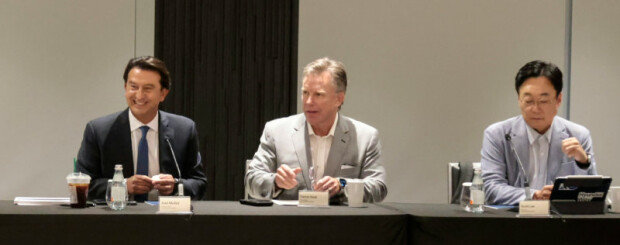
“We have consistently set targets assuming 25 percent tariffs. Prices are a matter of supply and demand, not tariffs.”
José Muñoz, president and global COO of Hyundai Motor, explained the company’s tariff strategy during a media roundtable on Sept. 18 in New York after the CEO Investor Day event. “This is a time when we must think and act with great care,” he said. Muñoz also noted that despite the United States imposing a 25 percent tariff on imported cars since April, Hyundai has not raised prices. “What we must do is not simply increase prices but work to maximize balance between supply and demand within the market,” he added.
Although Seoul and Washington reached an agreement in July to lower auto tariffs from 25 percent to 15 percent, follow-up negotiations have stalled, leaving Korean exports still subject to the 25 percent rate. Japanese automakers, however, saw their tariffs reduced to 15 percent on Sept. 16, intensifying competition in the U.S. market. Even in this environment, Hyundai used the Investor Day event to announce plans to invest 77.3 trillion won by 2030 and achieve annual global sales of 5.55 million vehicles.
Asked whether Hyundai could maintain current prices if high tariffs persist, Muñoz warned of side effects such as a decline in market share from raising prices. “What we need now is to find ways to maximize demand,” he said. “In fact, we are delivering vehicles with excellent design and top safety ratings, such as the Insurance Institute for Highway Safety’s ‘Top Safety Pick Plus,’ that customers can confidently choose.”
Muñoz acknowledged, however, that prices could rise when new models are launched with added features. At the event, Hyundai announced plans to introduce a large pickup truck in North America and new electric vehicles in India and Europe. Addressing concerns that Hyundai may struggle against entrenched local competitors, he expressed confidence. “Our manufacturing, engineering and operational capabilities are all strong,” he said. “Based on those strengths, entering segments where we lack experience is not a risk but an opportunity.”
Some observers have voiced concern that Hyundai’s expansion of overseas production could reduce the role of the Korean market. In its announcement, Hyundai projected that the share of domestic sales in its global total would fall from 17 percent today to 13 percent by 2030.
Muñoz dismissed the concern, clarifying, “This means producing local models locally. It does not mean cannibalizing our Korean business.” With the company’s global sales target rising from 4.17 million units this year to 5.55 million in 2030, he said, Korean operations would also expand. “We plan to boost capacity by 200,000 units through the new Ulsan plant,” he added. “There is no shifting of Korean production to the U.S., and the direction we are moving in should not be a cause for concern.”
Hyundai Motor also addressed the recently enacted “Yellow Envelope Law,” amendments to Articles 2 and 3 of the Trade Union Act, in Korea. “Investors, including the American and European chambers of commerce, have expressed concerns," Chief Financial Officer Lee Seung-jo, who joined Muñoz at the briefing, said. "But as the law has been passed and is soon to be implemented, we will do our best to comply with it.”
Woo-Sun Lim imsun@donga.com

![[속보]트럼프 “이란과 14일 합의 서명”…혁명수비대 “절대 없을 것”](https://dimg.donga.com/c/138/175/90/1/wps/NEWS/IMAGE/2026/06/14/134105551.1.jpg)





 About Dong-A Ilbo