

Former judge highlights legal failures in U.S. worker detentions
Former judge highlights legal failures in U.S. worker detentions
Posted September. 20, 2025 07:15,
Updated September. 20, 2025 07:15
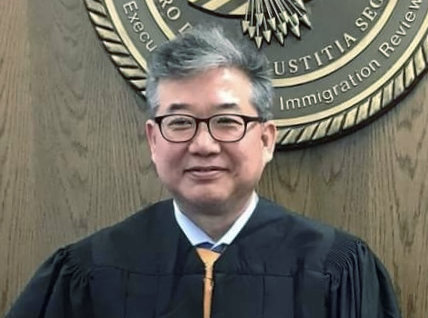
“I was in court on the afternoon of Sept. 4 when an email alert appeared on my monitor with the subject line ‘Termination Notice.’ At that moment, I thought, ‘It has finally come.’”
David Kim (Kim Kwang-soo), a former judge at the U.S. New York Federal Immigration Court who was abruptly terminated by the second Trump administration, said this in an interview with The Dong-A Ilbo on Sept. 18. Kim, who immigrated to the United States after completing his first year of high school in 1983, is a recognized immigration law attorney and became the first Korean American appointed as a U.S. federal immigration judge in 2022. News that he was recently dismissed through what amounted to a “three-line email” has reignited debate in the U.S. legal community over the Trump administration’s efforts to influence the judiciary and its hardline immigration policies.
“After the start of Trump’s second term, dozens of immigration judges were already dismissed. They all received emails stating, ‘Under the authority of the President pursuant to Article II of the U.S. Constitution, as of today, you are no longer an immigration judge,’” Kim said. “I do not know the exact reason for my termination, but most of those dismissed, including myself, were judges with high asylum approval rates.”
According to TRAC, a nonprofit data analysis organization at Syracuse University, Kim’s asylum approval rate was 96.9%, far higher than the average dismissal rate of 34.8% for other New York federal immigration judges. Kim explained, “The reason my approval rate was high is that I could not tolerate attorneys who did not put their best effort into representing clients, so I would instruct them to improve before proceeding with the trial.” He emphasized, “Deportation hearings decide not just one individual’s life but the lives of their entire family, so one has to be extremely careful.”
As an immigration law expert, Kim also offered guidance on the recent arrests and detentions of Korean workers at the Hyundai-LG Energy Solution joint battery plant in Georgia (HL-GA). He said, “Even a quick look at media reports shows clear procedural issues, such as ICE agents threatening and detaining workers. The U.S. is a country with established procedural law, so if ICE failed to follow legally required steps in implementing immigration law, it is unlawful.”
With growing calls among detainees recently returned to Korea for legal action, he advised, “Since more than 300 people were affected, pursuing a class-action lawsuit might be the most effective way to seek legal remedies.” He also suggested utilizing the Alien Tort Claims Act (ATCA), which allows foreigners to file claims for mental or physical harm caused by the U.S. He added, “The Korean government should exercise its capacity in this matter, and I am willing to assist wherever I can.”
Kim, who immigrated to the U.S. with his father, a pastor, recalled studying with the memory of friends who told him, “Go to America and succeed, but never forget us.” “Thinking about the many days I worked hard to learn English, I understand the immigrant’s mindset better than anyone," he said. "Immigration law is challenging, but those who take it seriously earn deep respect.”
Following his termination, Kim has received offers from several prestigious immigration law firms and is expected to return to practice as an immigration attorney.
Woo-Sun Lim imsun@donga.com

![[단독]韓정부, 하메네이 장례식 불참…“이란측에서 난색 표해”](https://dimg.donga.com/c/138/175/90/1/wps/NEWS/IMAGE/2026/07/05/134237981.1.jpg)





 About Dong-A Ilbo