

Lee proposes phased denuclearization plan for North Korea
Lee proposes phased denuclearization plan for North Korea
Posted August. 22, 2025 07:11,
Updated August. 22, 2025 07:11
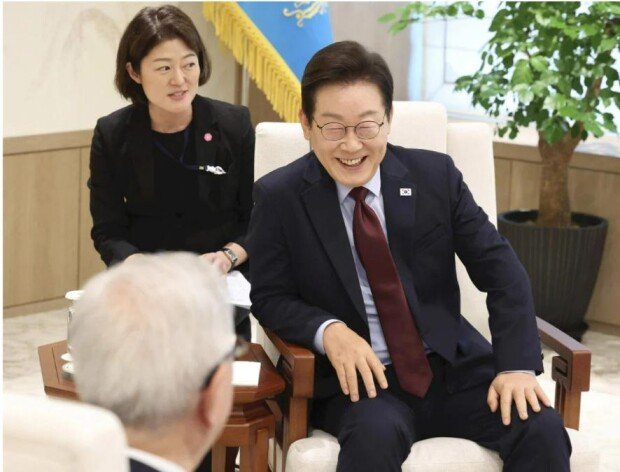
On Aug. 21, President Lee Jae-myung outlined a three-step roadmap for North Korea’s nuclear program, saying the process would begin with a freeze on weapons and missiles, followed by reductions and eventual denuclearization. This is the first time Lee has proposed a phased plan in which a freeze serves as the starting point for negotiations. The plan then advances through gradual steps toward disarmament, with compensation provided at each stage. The proposal comes as calls grow in the U.S. for a nuclear freeze and arms reduction talks, prompting concern that it could be seen as de facto acceptance of North Korea as a nuclear state.
On Aug. 23, ahead of the South Korea-Japan summit, Lee told Japan’s Yomiuri Shimbun that his administration’s policy goal is the denuclearization of the Korean Peninsula. He said the South Korean government will work to create conditions for a freeze, reduction, and elimination of nuclear weapons through active inter-Korean dialogue, while maintaining close coordination with the U.S.
Lee’s denuclearization proposal introduces a reduction phase to the “freeze and dismantlement” framework advanced by the Moon Jae-in administration. As North Korea’s nuclear capabilities have advanced over the past eight years, the plan seeks phased denuclearization in a “small deal,” according to officials. Earlier, South Korea’s National Intelligence Service projected that the second Trump administration’s denuclearization policy could also take the form of a “small deal” involving a freeze and arms reduction.
There are concerns that if negotiations with North Korea shift from denuclearization to a framework of nuclear freeze and arms reduction, it could be seen as recognizing the country as a de facto nuclear power.
President Lee also expressed for the first time his intention to uphold existing agreements on wartime forced labor and comfort women. He said these commitments between states should not be overturned and added that the government’s long-standing position remains that the 2015 comfort women agreement is an official accord between the two governments.
Ahead of his summit with Japanese Prime Minister Shigeru Ishiba, Lee said there are no historical disputes. Observers say the statement highlights to the U.S. the importance of strengthening trilateral cooperation among South Korea, the U.S., and Japan.
On economic cooperation with Japan, President Lee said it is time to discuss creating a solid economic framework among Pacific Rim countries, including those in East Asia. His remarks are seen as signaling South Korea’s potential accession to the Comprehensive and Progressive Agreement for Trans-Pacific Partnership (CPTPP), which Japan launched in 2018.
Hoon-Sang Park tigermask@donga.com



![[단독]“신천지 신도 최소 5만6472명, 2021∼2024년 국힘 당원 가입”](https://dimg.donga.com/c/138/175/90/1/wps/NEWS/IMAGE/2026/06/22/134157752.1.jpg)



 About Dong-A Ilbo