

Korean EDM Festival makes high-impact Japan debut
Korean EDM Festival makes high-impact Japan debut
Posted July. 02, 2025 07:52,
Updated July. 02, 2025 07:52
“So baby pull me closer in the back seat of your Rover…”
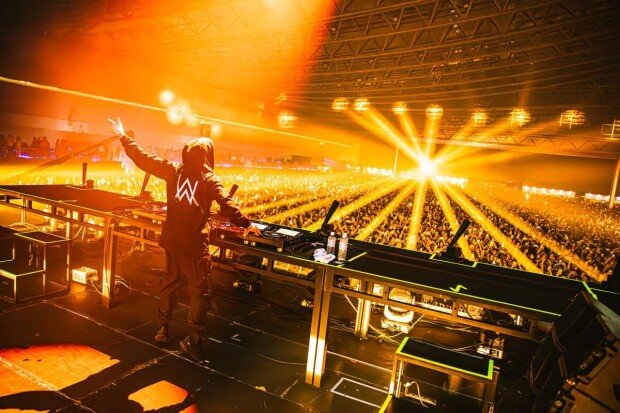
On the afternoon of June 29 at Makuhari Messe International Exhibition Hall in Chiba, Japan, American DJ duo The Chainsmokers softly recited the opening line of their 12-week Billboard-topping hit “Closer” a cappella. The crowd immediately joined in: “We ain’t ever getting older.”
As the beat dropped, the audience erupted. Japanese concertgoers, often known for their quiet appreciation of live performances, waved their arms, turned on phone flashlights, and cheered enthusiastically.
Held June 28 and 29, World DJ Festival Japan marked the first international expansion of World DJ Festival, South Korea’s leading electronic dance music event. About 40 major DJs took the stage, including The Chainsmokers, Alan Walker, KSHMR, and Nicky Romero, many of whom had also performed at the Korean edition.
The event attracted 52,000 attendees over two days and sold out entirely through pre-sale. About 70 percent of the audience was in their 20s, and 98 percent of ticket holders were Japanese residents. True to Japan’s “open run” culture, hundreds lined up hours before the doors opened.
Launched in 2007, World DJ Festival is a fully original Korean brand. This was the first time a Korean-created EDM festival had been held abroad. Korean production company BEPC Tangent led the overall production. Japanese influencer marketing firm Samurai Partners co-hosted the event by acquiring a license from BEPC. Rather than a standard branding deal limited to logos or naming rights, this partnership included stage design, creative direction, and artist selection, ensuring a locally tailored experience.
“This proves that a festival developed in Korea’s competitive market can also succeed across Asia and around the world,” said BEPC CEO Kim Eun-seong. “World DJ Festival creates moments where people can sing along to global hits and share memories worth keeping.” Samurai Partners CEO Hiroyuki Irie added, “I’ve been to every festival in the global top 100, and this had the best overall quality. It might even surpass Tomorrowland.”
Although the Japanese edition was held indoors to avoid the rainy season, it closely resembled the original. Kim said his team initially worried that Korea-Japan relations might call for reducing Korean elements. “But to our surprise, the Japanese side wanted more Korean content,” he said. “It shows how Korean culture appeals to Japan’s younger generation.”
Kenichi Yoshida, 29, who attended both days, said he found the event through Instagram. “The lineup, the music, and the overall production were excellent,” he said. “I hope Hardwell comes next year.”
Local adaptations included a stylized “WDJF” logo in traditional Japanese calligraphy and a signature fragrance that filled the venue. While the visual effects were less extravagant than those in Korea, the indoor sound system delivered powerful audio. The venue also included wheelchair-accessible seating and ramps.
BEPC is in talks to bring the festival to five more countries. “We once looked to overseas festivals as models,” Kim said. “Now it is time to export Korea’s production systems and stage direction. We aim to showcase the country’s creative and technical strengths to audiences around the world.”
도쿄=사지원기자 4g1@donga.com





 About Dong-A Ilbo