

South Korea enacts punitive damages law on misinformation
South Korea enacts punitive damages law on misinformation
Posted December. 25, 2025 10:49,
Updated December. 25, 2025 10:59
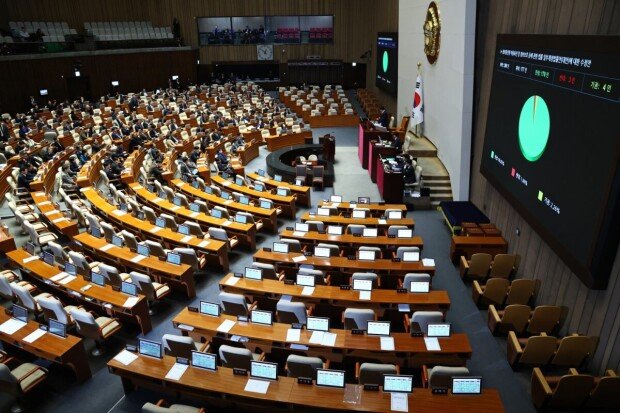
A revised Information and Communications Network Act that allows courts to impose punitive damages of up to five times actual losses on media outlets or YouTubers who deliberately spread false or manipulated information was passed by the National Assembly on Dec. 24. The Democratic Party of Korea has promoted the revision, arguing that false and manipulated content spreads rapidly online, amplifying confusion and hatred and requiring stronger corrective measures. Opposition parties denounced the bill as an “online gag law,” while civic groups, including the People’s Solidarity for Participatory Democracy, warned that it could undermine the media’s role as a watchdog over power. Despite such objections, the ruling party pushed the bill through.
Efforts to curb the indiscriminate spread of false and manipulated information are undoubtedly necessary. The illegal conduct of some malicious YouTubers, including so-called cyber wreckers who profited by circulating false claims involving YouTuber Tzuyang, deserves strict punishment. However, serious unintended consequences are likely if the revised law is enforced in a way that extends to legitimate news reporting. The criteria for determining what constitutes false or manipulated information remain vague, leaving substantial room for arbitrary interpretation. When punitive damages of up to five times actual losses are applied under such ambiguous standards, the media’s ability to report freely and aggressively is bound to be severely constrained.
There is particular concern that politicians, senior public officials, and government agencies could increasingly resort to so-called strategic lawsuits against public participation, filing damage claims preemptively to prevent the spread of unfavorable coverage. The mere filing of such lawsuits can damage the credibility of media organizations, while reporters may hesitate to pursue follow-up reporting. Media outlets also face substantial time and financial costs in responding to litigation. The Democratic Party of Korea contends that the law poses no problem because it allows courts to dismiss lawsuits through interim rulings if they are clearly intended to suppress reporting. Experts, however, warn that the inherently ambiguous nature of false and manipulated information makes it likely that such cases will drag on. If media coverage of alleged misconduct involving politicians or senior officials is stifled, the ultimate victims will be the public.
In jurisdictions such as California, U.S. courts that determine a lawsuit was maliciously filed to silence defendants, including media organizations, require plaintiffs to cover litigation costs and allow defendants to file counterclaims for damages. South Korea should consider similar measures under which plaintiffs who file lawsuits to block follow-up reporting, despite knowing the reporting to be accurate, would be required to pay up to five times the damages suffered by media outlets and journalists if the reporting is later confirmed as factual. Such provisions could reduce the risk that the law evolves into a harmful statute that effectively muzzles the press.







 About Dong-A Ilbo