

Court issues new warrants in Pyongyang drone case
Court issues new warrants in Pyongyang drone case
Posted December. 25, 2025 11:09,
Updated December. 25, 2025 11:09
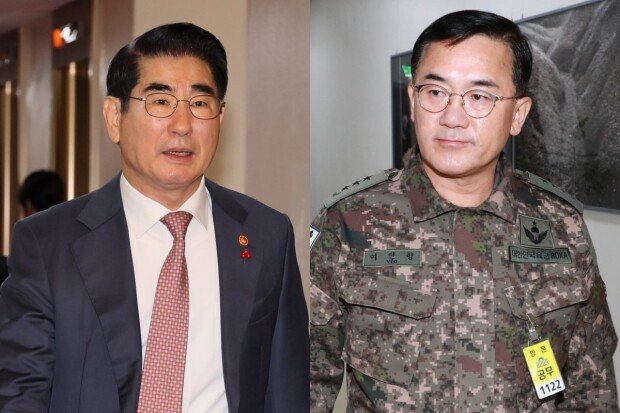
A court on Tuesday issued additional arrest warrants for former Defense Minister Kim Yong-hyun and former Defense Counterintelligence Command chief Yeo In-hyung on charges of general treason tied to the so-called Pyongyang drone operation. It marked the third time arrest warrants have been issued for the two men since the declaration of martial law on Dec. 3 last year. The ruling has heightened expectations that the court may also approve an additional arrest warrant for former President Yoon Suk Yeol, who is accused as an accomplice and underwent a detention hearing the previous day.
● Court cites risk of evidence destruction in third warrants
The Seoul Central District Court’s Criminal Division 36, which is overseeing the first trial on general treason charges involving Yoon, Kim and Yeo, issued the warrants on Dec. 24, citing concerns that the two could destroy evidence. Kim was previously detained on charges that he played a central role in the insurrection linked to the declaration of martial law. In June, a separate warrant was issued alleging that he deceived the Presidential Security Service into providing an encrypted phone to Noh Sang-won, a former Defense Intelligence Command chief who is now a civilian. Yeo was detained in December last year on charges that he played a key role in the insurrection by mobilizing counterintelligence agents on the day martial law was declared. He was arrested again in June on perjury charges. The court decided to issue the additional warrants after noting that Kim’s detention was set to expire at midnight on Dec. 25, while Yeo’s detention was due to expire at midnight on Jan. 2 next year.
The court is widely believed to have considered that the Pyongyang drone operation was carried out covertly and shared with only a small number of military personnel. If the two former senior commanders were released, they could potentially exert influence over officials at the Drone Operations Command who were involved in executing the mission. During a closed-door detention hearing the previous day, Yoon argued that it constituted illegal double prosecution for the special counsel to characterize the drone operation as preparation for martial law while pursuing general treason charges rather than insurrection charges. He also maintained that there was no risk of evidence destruction. However, the court’s decision to issue arrest warrants on general treason charges for Kim and Yeo, both already indicted for their roles in the insurrection, indicates that Yoon’s arguments were not accepted.
● Ruling on Yoon’s additional detention expected early next year
A decision on whether to issue an additional arrest warrant for Yoon is expected in early January. Yoon, who is currently detained on charges of obstructing an arrest, is scheduled to remain in custody through Jan. 18, requiring the court to rule before that date. During the detention hearing, the court instructed Yoon’s legal team to submit any additional written opinions by Dec. 30.
If an additional arrest warrant is issued, the special counsel plans to visit the Seoul Detention Center on Jan. 18, when Yoon’s current detention expires, to execute the warrant. In that scenario, Yoon’s detention could be extended by up to six months, through July.
Analysts say the likelihood of Yoon’s release remains low even if appellate proceedings extend into July. The Seoul Central District Court’s Criminal Division 35 is scheduled to deliver a verdict on Jan. 16 on Yoon’s charge of obstructing an arrest by the Corruption Investigation Office for High-Ranking Officials. If the court imposes a prison sentence, Yoon could be detained for an additional six months during the appeals process. Separately, the court’s Criminal Division 25 is expected to hold closing arguments in January on charges that Yoon led an insurrection and to issue a verdict before the regular judicial reshuffle in February. A prison sentence in that case could likewise result in up to six months of additional detention during appeal.
Yoon is already standing trial in six separate cases simultaneously. The special counsel may also seek additional arrest warrants tied to other allegations for which warrants have not yet been issued, including claims of undue pressure in the investigation into the death of Corporal Chae and allegations surrounding the appointment of the ambassador to Australia.
고도예 기자 yea@donga.com




 About Dong-A Ilbo