

Trump suggests possible early end to Iran war
Trump suggests possible early end to Iran war
Posted March. 11, 2026 08:46,
Updated March. 11, 2026 08:46
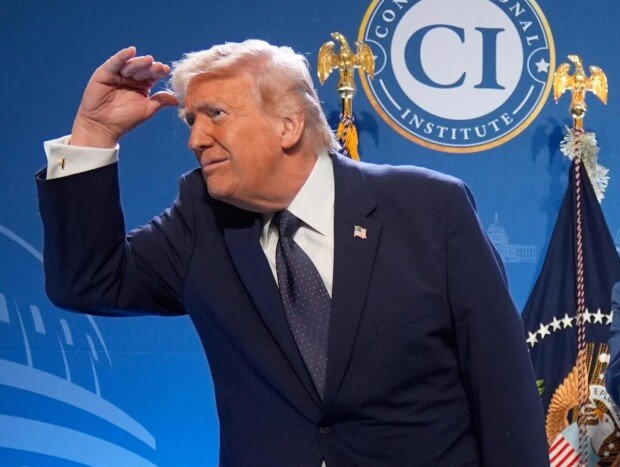
U.S. President Donald Trump on March 9 described the war with Iran as a “short-term excursion” and said it would end “very soon.” Analysts interpret his comments as signaling a potential early exit strategy, coming as international oil prices surged, briefly approaching $120 per barrel, reflecting the growing economic impact of the conflict.
At a news conference at the Doral Resort in Miami, Florida, Trump said, “We are far ahead of the initial operational schedule. Everything they had is gone,” asserting that the war would end soon. He repeated the description of the conflict as “short-term” at a Republican Party event later the same day.
On March 7, Trump had said the United States would conduct the war “as long as necessary,” signaling a readiness for a prolonged conflict. His sudden hint at an early conclusion just two days later is viewed as a response to rising oil prices caused by Iran’s blockade of the Strait of Hormuz and growing public unease over the war. With U.S. gasoline costs climbing ahead of the November midterm elections, antiwar sentiment has intensified political pressure.
Trump emphasized the administration’s focus on stabilizing energy markets, telling reporters, “We are concentrating on keeping oil and energy flowing to the world while the operation continues.” U.S. Energy Secretary Chris Wright said on March 9 that the United States was discussing coordinated releases from strategic petroleum reserves with the Group of Seven nations.
Despite hinting at a quick end, Trump added, “We will not stop until the enemy is completely and decisively defeated.” He also maintained his previous stance of refusing to recognize the recent election of Moztaba, the hardliner son of former Supreme Leader Ali Khamenei, as Iran’s new supreme leader following the death of Khamenei’s son in a U.S.-Israel airstrike on February 28. The approach suggests that while Trump is seeking to calm markets and public opinion, pressure on Iran remains firm.
Meanwhile, Iran’s Islamic Revolutionary Guard Corps, a central pillar of the regime often described as a “state within a state,” responded to Trump’s remarks by declaring, “The end of the war is up to us.” Observers interpret the announcement as a signal of continued resistance under Moztaba’s leadership.
Jin-Woo Shin niceshin@donga.com

![[천광암 칼럼]부정선거론에 올라탄 장동혁의 혹세무민](https://dimg.donga.com/c/138/175/90/1/wps/NEWS/IMAGE/2026/06/14/134110329.1.jpg)
![[오늘의 운세/6월 15일]](https://dimg.donga.com/c/138/175/90/1/wps/NEWS/IMAGE/2026/06/15/134110701.1.jpg)



 About Dong-A Ilbo