

U.S. moves THAAD missiles from South Korea to Mideast
U.S. moves THAAD missiles from South Korea to Mideast
Posted March. 11, 2026 08:46,
Updated March. 11, 2026 08:46
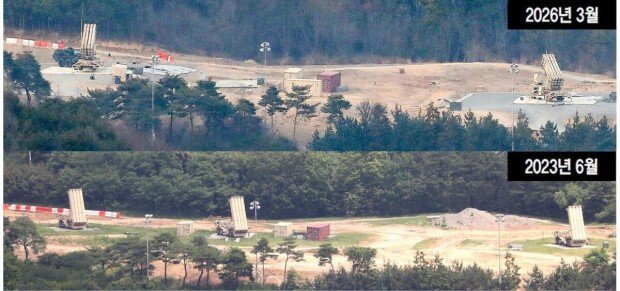
U.S. forces in South Korea recently removed some interceptor missiles deployed with the THAAD (Terminal High Altitude Area Defense) system at the Seongju base in North Gyeongsang Province, officials said. With the United States engaged in a war in Iran, the move appears part of a broader effort to deploy key U.S. weapons overseas, even as some THAAD assets, vital for South Korea-U.S. air defense against North Korean threats, are being prepared for potential relocation. Officials warn that a prolonged redeployment could leave enduring gaps in the peninsula’s air defense network.
Multiple government sources told reporters on March 10 that U.S. forces recently transported some THAAD interceptor missiles to an undisclosed location. One source said, “It is believed the THAAD interceptors were moved to Osan Air Base in Pyeongtaek, Gyeonggi Province, where Patriot batteries from other U.S. bases are concentrated.” A single THAAD battery includes a fire control unit, radar, and six launchers. Each launcher carries eight interceptors, meaning one battery can hold up to 48 missiles. Military observers suggest that the number of THAAD interceptors potentially sent to the Middle East could reach several dozen.
The Washington Post reported on March 9, citing two U.S. Department of Defense officials, “Some of the THAAD systems deployed in South Korea are being moved to the Middle East.” In South Korea’s layered air defense network, Patriot missiles cover lower altitudes below 40 kilometers, while THAAD systems defend higher altitudes ranging from 40 to 150 kilometers.
Since THAAD was deployed in 2017, U.S. forces have publicly conducted multiple exercises moving interceptor missiles from Camp Carroll in Waegwan, North Gyeongsang Province, to the Seongju base to load them onto THAAD launchers. It is now suggested that missiles stored at Camp Carroll may have been the ones recently relocated. A senior government official told The Washington Post that the moves were carried out after full consultation between South Korea and the United States.
President Lee Jae-myung said at a Cabinet meeting on March 10, “We have voiced objections to U.S. forces removing some air defense weapons for their own needs, but the reality is that we cannot fully enforce our position.” He added, “We must ensure we have the independent defense capabilities necessary to protect ourselves.” Analysts interpret Lee’s remarks as recognition that the U.S. policy of strategic flexibility for forces in South Korea, long promoted by the Trump administration, is now taking shape and that South Korea must prepare accordingly.
Kyu-Jin Shin newjin@donga.com






 About Dong-A Ilbo