

[Editorial] Private School Law
[Editorial] Private School Law
Posted February. 28, 2007 06:53,
The Uri Party has agreed with the Grand National Party to revise the Private School Act by March 6. The education reform bill was railroaded by the Uri Party in December 2005 by taking in all the demands made by the Korean Teachers and Educational Workers` Union (KTU). The open school board system, the one of the most poisonous clauses of the law, was made according to the logic of the KTU, which demanded privately-run schools to include outside personnel in their boards of directors. Although the private school bill was a bad law that infringed on the autonomy of private schools and made the management of private schools swayed by outside figures, the Uri Party lawmakers celebrated the passage of the bill, even cuddling with each other and shedding tears.
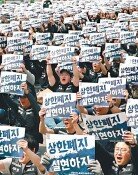
However, they have changed their attitude due to strong resistance by the religious circles. Christian communities held a rally against the private school law and some 100 of them shaved their heads in protest. In response, some lawmakers expressed their concerns, saying, Even pastors are now shaving their heads, and we can no longer ignore the situation. However, we cannot help but suspect their true intention if they agreed to do the revision simply due to pressure by religious communities.
Some experts also point out that the Uri Party shifted their position based on political calculation as they do not want to lose the votes of the religious communities ahead of the presidential elections in December and the general elections in 2008. The Uri Party announced that it is reviewing a measure that would allow religious bodies to recommend half of the board of directors in acknowledgement of religious organizations objectives in establishing private schools. However, this is totally one sided and unfair. So ignoring the initial objectives of non-religious private schools, which make up 76 percent of private schools, is fine?
The Uri Party is also reviewing a measure that would allow private schools to set their own qualifications criteria for board directors while maintaining the open board system. However, the open board system is against the principles of democracy that guarantees private entities to have autonomy in choosing their own staff. Therefore the private school law should not be revised, but, instead, abolished. The Grand National Party should not hesitantly negotiate with the Uri Party as well.
The Uri Party has been neglecting other education policies since it became blinded with the false ideals of the private school law in 2004. Meanwhile, the competitiveness of schools has repeatedly regressed. However, the Uri Party seems to be too busy in counting the votes that they neglected the essence of the problems regarding the private school law. Before the Uri Party begins their negotiation over the revision of the school reform law, they should apologize to the public first for the lost three years of our education.

![[속보]호르무즈서 교전…이란 “유조선 공격하는 미군 격퇴”](https://dimg.donga.com/c/138/175/90/1/wps/NEWS/IMAGE/2026/05/08/133883338.3.jpg)




 About Dong-A Ilbo