

North Korea adds territorial clause, expands nuclear powers
North Korea adds territorial clause, expands nuclear powers
Posted May. 07, 2026 07:45,
Updated May. 07, 2026 07:45
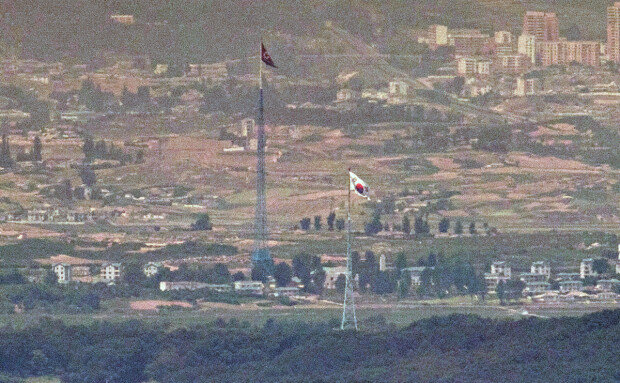
North Korea has added a territorial clause to its revised constitution and removed references to unification, according to details disclosed May 6. The amendments also allow leader Kim Jong Un to delegate authority over nuclear weapons use to a designated command body, creating a constitutional basis for what analysts describe as a “nuclear trigger” system.
The updated constitution, unveiled at a briefing for reporters covering the Unification Ministry, states in Article 2 that the Democratic People’s Republic of Korea borders China and Russia to the north and South Korea to the south, and includes the land, territorial waters and airspace defined on that basis. References to unification and ethnic unity have been deleted.
The changes reflect Pyongyang’s “two hostile states” policy, formally defining the two Koreas as separate countries divided by a boundary. It is the first time since the regime’s founding in 1948 that North Korea has explicitly spelled out a territorial clause in its constitution. The move contrasts with Article 3 of South Korea’s Constitution, which defines the entire Korean Peninsula as its territory, raising concerns about potential friction over competing claims.
The revised constitution also stipulates in Article 89 that command over North Korea’s nuclear forces rests with Kim Jong Un, chairman of the State Affairs Commission, and that he may delegate authority to use those forces to a national nuclear command body. The provision reinforces Kim’s exclusive control over the nuclear arsenal while signaling the possibility of a nuclear strike under certain conditions. Explicitly codifying such authority in a constitution is rare.
Park Won-gon, a professor of North Korean studies at Ewha Womans University, said elevating nuclear use authority to the constitutional level appears aimed at enabling preemptive and rapid strikes. He added that the framework could allow a nuclear response to proceed automatically even if Kim is unable to make a decision in a crisis.
The revised constitution also removes the phrase “Kim Il Sung-Kim Jong Il Constitution” from the preamble and expands the powers of the State Affairs Commission chairman, a change seen as further consolidating Kim Jong Un’s rule.
Oh-Hyuk Kwon hyuk@donga.com




 About Dong-A Ilbo