

Trump urges South Korea to join U.S. maritime mission near Iran
Trump urges South Korea to join U.S. maritime mission near Iran
Posted May. 06, 2026 07:56,
Updated May. 06, 2026 07:56
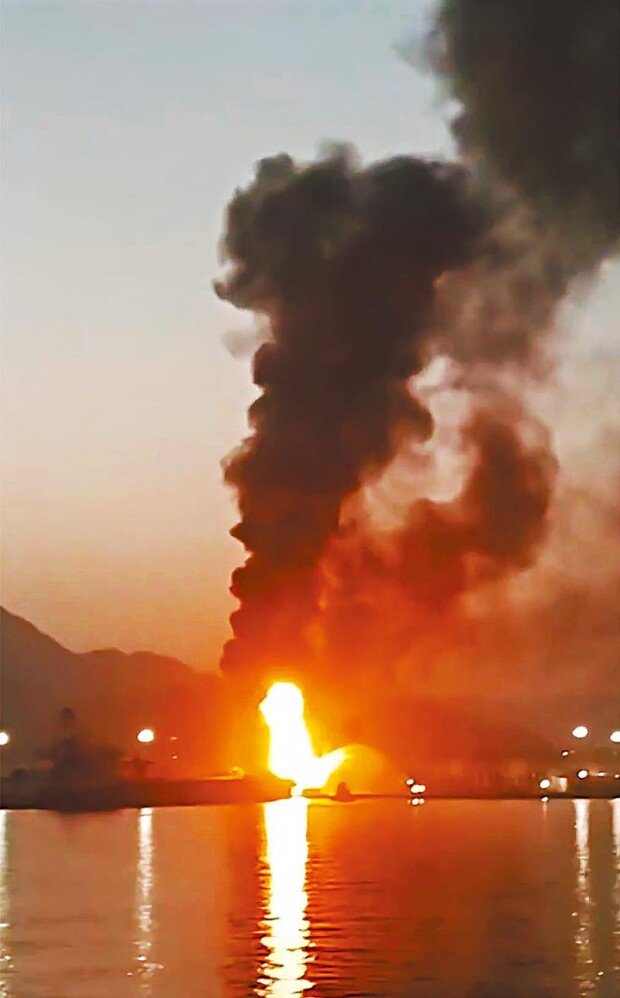
U.S. President Donald Trump said Sunday on Truth Social (local time) that Iran had attacked what he described as “unrelated countries” during an operation he called “Project Freedom,” adding that a South Korean cargo vessel was among those affected.
“It is time for South Korea to join this mission,” Trump wrote, urging Seoul to support Washington in its confrontation with Iran. In a separate phone interview with ABC the same day, he repeated the claim, saying, “There was fire directed at a South Korean vessel. South Korea should take action.”
Trump’s remarks followed reports that an explosion involving the HMM-operated cargo ship Namu, anchored in the Strait of Hormuz, was linked to an Iranian attack. The strait is a vital global oil shipping corridor.
The United States began a military operation Sunday aimed at helping commercial vessels trapped in the waterway exit safely amid Iranian restrictions. Washington said the effort is intended to stabilize volatile oil markets and increase pressure on Tehran amid a prolonged standoff.
With Trump directly naming South Korea, observers say Washington could seek more active participation from Seoul, including potential naval deployment. For the South Korean government, however, such a move would carry significant diplomatic and security risks, including the possibility of direct friction with Iran. At the same time, rejecting the request outright could strain ties with Washington.
Trump has recently expressed frustration with Germany over what he sees as insufficient cooperation on Iran-related efforts and has reportedly approved a reduction of 5,000 U.S. troops stationed there.
A presidential office official in Seoul said Monday that South Korea is reviewing the U.S. proposal regarding the Strait of Hormuz, taking into account domestic legal procedures and military readiness. “South Korea and the United States are maintaining close communication on the stable use of major sea lanes, including the Strait of Hormuz,” the official said.
Meanwhile, tensions in the region continue to intensify. Gen. Brad Cooper, commander of U.S. Central Command, said Sunday that two commercial vessels escorted by the U.S. Navy successfully transited the Strait of Hormuz.
During the operation, U.S. Army Apache helicopters sank six Iranian fast attack craft that had threatened the ships, while U.S. Navy vessels intercepted Iranian cruise missiles and drones, Cooper said. Iran, however, claimed the United States struck civilian vessels rather than military targets.
The Islamic Revolutionary Guard Corps warned it would “use force to stop any vessel that violates our principles” in the Strait of Hormuz. Iran also launched missile and drone attacks toward the United Arab Emirates the same day.
It marked Iran’s first strike against a pro-U.S. country in the Middle East since a ceasefire with the United States on June 8, raising concerns that the confrontation between Washington and Tehran is moving closer to a broader conflict.
Jin-Woo Shin niceshin@donga.com



![[김순덕 칼럼]장동혁 심판이냐, ‘공소취소’ 심판이냐](https://dimg.donga.com/c/138/175/90/1/wps/NEWS/IMAGE/2026/05/06/133874674.1.jpg)




 About Dong-A Ilbo