

U.S. urges South Korea to join maritime security effort near Iran
U.S. urges South Korea to join maritime security effort near Iran
Posted May. 06, 2026 07:55,
Updated May. 06, 2026 07:55
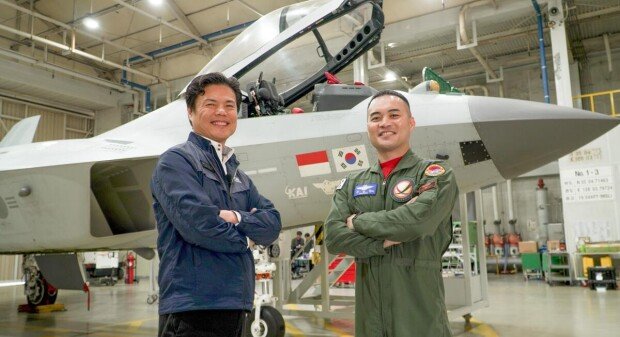
“Even the placement of cockpit switches came under review. In combat, reaction time is everything.”
At a Korea Aerospace Industries (KAI) hangar in Sacheon on April 29, Lt. Col. Jeon Seung-hyun, commander of the Air Force’s 281st Test Flight Squadron, described how extensively pilots contributed to refining South Korea’s KF-21 mass-production fighter jet.
Jeon said pilots offered granular feedback throughout the cockpit design process, questioning why certain switches were positioned out of easy reach and why key information was not displayed more intuitively, all in an effort to improve usability and operational speed.
The KF-21, South Korea’s first domestically developed supersonic fighter, was unveiled on March 25 this year. The program spans more than two decades, including 10 years of feasibility studies and another decade from system development to mass production. It completed more than 1,600 test flights without a single accident, a milestone widely regarded as a major achievement.
The program’s success was built on close coordination between manufacturer Korea Aerospace Industries and the Republic of Korea Air Force as the end user. While KAI focused on technical performance and system integration, the Air Force pressed for maximum operational efficiency, producing an iterative process of back-and-forth adjustments that at times resembled a partnership and at others a demanding client-supplier relationship.
“If pilots find the aircraft difficult to operate, it loses its value, no matter how advanced it is,” said Kim Beom-yong, head of KAI’s systems engineering team. “The key was to reflect as much feedback as possible from the pilots who actually fly it.”
The cockpit was one of the most closely scrutinized areas. To improve reaction time by even fractions of a second, the Air Force divided the pilot’s reachable space into three zones and tested accessibility in each. Engineers mapped movements ranging from minimal hand motions to those requiring shoulder or full-body shifts, then adjusted the placement of key controls accordingly. In some cases, even the shape of switches was redesigned. The layout also accounted for differences in pilot height and body type.
Pilot input also influenced the aircraft’s external design. Kim said pilots reported feeling subtle vibrations near the rear fuselage. “We traced it to airflow issues and ended up redesigning the rear section,” he said.
Jeon recalled initially describing the issue in simpler terms. “I said it felt a bit unsettling to fly, like it could interfere with operations,” he said. “They took it seriously and made adjustments. When I flew the verification mission later, the aircraft felt noticeably more refined.”
The Air Force is now preparing to establish a dedicated KF-21 squadron. “There is already a long line of younger pilots eager to fly the KF-21, a source of national pride,” Jeon said. “Even pilots who are not currently flying say they want a chance to get into the cockpit. The enthusiasm is strong.”
KAI is now working to evolve the KF-21, currently classified as a 4.5-generation fighter, into a more capable platform. “The KF-21 is not a finished product but a starting point,” Kim said. “We plan to enhance stealth capabilities by refining semi-exposed structural elements into more integrated designs and continue developing derivative models.”
사천=변종국 bjk@donga.com

![한적한 시골 단위농협… 알고보니 ‘대포통장 발급 전국 2위’[히어로콘텐츠/히든②-下]](https://dimg.donga.com/c/138/175/90/1/wps/NEWS/IMAGE/2026/06/23/134161455.1.jpg)


![금고 전무 “통장 풀었다 ㅎㅎ” 피싱 신고자 신상 508번 조직에 넘겨[히어로콘텐츠/히든②-上]](https://dimg.donga.com/c/138/175/90/1/wps/NEWS/IMAGE/2026/06/22/134161350.1.jpg)


 About Dong-A Ilbo