

Record exports conceal mounting economic risks
Record exports conceal mounting economic risks
Posted July. 02, 2026 08:28,
Updated July. 02, 2026 08:28
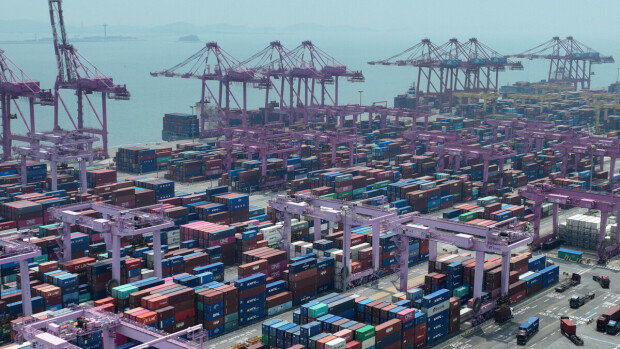
South Korea posted $102.25 billion in exports last month, becoming the first country after Germany, China and the United States to surpass $100 billion in monthly exports. The achievement places the country in rare company. Even Japan, once one of the world's dominant exporting nations, never crossed that threshold. Exports for the first half of the year also reached a record $496.7 billion, the highest six-month total on record. If the current pace continues, $1 trillion in annual exports and a place among the world's five largest exporters are increasingly within reach.
The latest figures underscore just how rapidly South Korea's exports have expanded. Overseas shipments in June rose 70.9% from a year earlier, the strongest annual increase since October 1978. Only three months after monthly exports first exceeded $80 billion, they climbed past the $100 billion mark. The gains came despite an increasingly difficult external environment shaped by rising protectionism and the U.S.-Iran conflict.
Semiconductors accounted for much of the surge. Chip exports tripled from a year earlier to more than $40 billion, the first time they have crossed that mark. First-half semiconductor exports alone have already outpaced last year's full-year total. Surging demand for advanced memory chips driven by AI, combined with sharply higher prices, fueled the remarkable performance. The AI investment boom also lifted exports of computers, electrical equipment and steel, while automobiles, petrochemicals, cosmetics and food products provided solid support.
The record-breaking performance, however, also highlights the economy's growing dependence on a single industry. Semiconductors made up 43.8% of total exports in June, leaving South Korea increasingly exposed to any downturn in the chip cycle or disruption to global supply chains. Labor tensions are also building amid disputes over performance bonuses and concerns over the Yellow Envelope Act. The Hyundai Motor union has announced it will refuse Sunday work and overtime beginning July 6, while the Korean Confederation of Trade Unions plans a nationwide strike on July 15. Beyond the semiconductor boom, business sentiment remains subdued across much of the corporate sector, and the labor market has yet to regain momentum.
South Korea's economy has produced a string of eye-catching numbers in the first half of the year. The Kospi has doubled in six months, and combined second-quarter operating profit at Samsung Electronics and SK hynix is expected to reach 150 trillion won. Those figures, however, should not breed complacency. Sustaining a $1 trillion export economy will require more than a booming semiconductor industry. It will depend on strengthening the economy's fundamentals by addressing its structural vulnerabilities before today's favorable conditions begin to fade.




![[오늘의 운세/7월 2일]](https://dimg.donga.com/c/138/175/90/1/wps/NEWS/IMAGE/2026/07/02/134221102.1.jpg)



 About Dong-A Ilbo