

Developing AI Autonomous Flight Technology for Swarm Drones: The Story of a MobilityLab Developer
Developing AI Autonomous Flight Technology for Swarm Drones: The Story of a MobilityLab Developer
Posted June. 23, 2026 10:44,
- Joohyoung Lee, a developer at MobilityLab, is leading the development of agricultural swarm drone technology that can cut pest control costs by over 60% while delivering up to eight times greater efficiency than conventional single-drone operations.
- The drones independently navigate and avoid obstacles using technologies like stereo vision and sensor fusion. MobilityLab provides a systematic environment that allows immediate transition from algorithm design to real-world field testing.
- Emphasizing the importance of hands-on field experience, MobilityLab plans to expand its autonomous flight technology beyond agriculture into diverse industries such as disaster management and defense.
The startup talent we are introducing this time is JooHyoung Lee, the AI Autonomous Flight Development Team Leader at MobilityLab. MobilityLab is a deep-tech company developing swarm drone solutions based on artificial intelligence (AI) autonomous flight technology. AI autonomous flight is a technology where multiple drones recognize each other's positions and missions without central control, simultaneously flying while detecting and avoiding on-site obstacles.
MobilityLab introduced an agricultural pest control solution using AI autonomous flight swarm drones, and through a Proof of Concept (PoC) conducted with the Agricultural Research & Extension Services, it verified effects such as a pest control cost reduction of over 60% and the spraying of an area more than 8 times larger in the same amount of time compared to existing single drones.
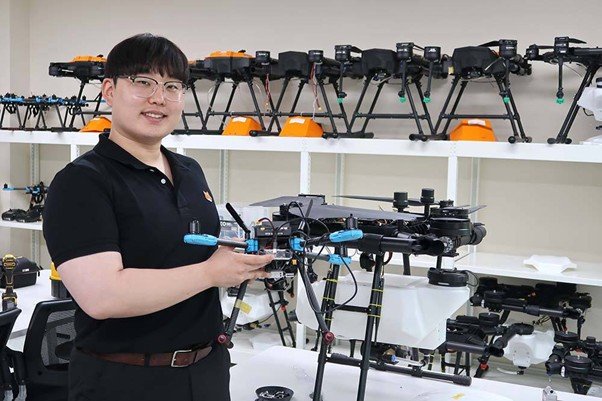
We met Team Leader JooHyoung Lee, who oversees the development of AI autonomous flight technology at MobilityLab, to talk about swarm drone AI autonomous flight technology. Team Leader JooHyoung Lee conducted research related to the tracking of high-speed underwater moving objects at the Agency for Defense Development(ADD), and later expanded his research area to the fields of autonomous moving objects and cognitive and navigation systems. Since joining MobilityLab in December 2024, he has been in charge of the AI Autonomous Flight Development Team, overseeing the design, implementation, and field verification of autonomous navigation systems operating in real-world environments.
From a Defense Researcher to an AI Autonomous Flight Developer
When did you join MobilityLab? What was the motivation for joining?
I joined in December 2024, during the early founding stage of MobilityLab. At that time, I had a strong desire to expand my experience by applying the technologies I had been researching to various industries outside of defense. Furthermore, I wanted to broaden my perspective by directly experiencing various processes from research to development and field application. Initially, I thought about founding a startup myself. However, there were quite a few bottlenecks during the preparation process. Therefore, I decided to join an early-stage startup, experience the growth process, and then challenge myself to start a business again. In doing so, I discovered MobilityLab and applied.
MobilityLab was developing swarm drones for agricultural pest control at the time, and I thought my research experience in autonomous moving objects, cognitive and navigation systems could contribute to solving technical challenges in agricultural fields. I decided to join MobilityLab because I could experience the entire product development process from technology development to real-world application, and because joining at the early stage of founding would allow me to take on more challenges.
It seems there would be many differences between the field of high-speed underwater moving objects you researched before joining and the swarm drone field.
The field I researched before joining was underwater communication technology, such as the tracking of high-speed underwater moving objects and ultra-long-distance underwater communication. This has similarities to the communication technology applied to swarm drones. This is because similar communication technologies are used for drones to determine each other's positions and movements during flight. Although the fields are different, there is a direct connection.
Drones Recognizing, Avoiding, and Flying Themselves: AI Autonomous Flight
What are your current responsibilities at MobilityLab?
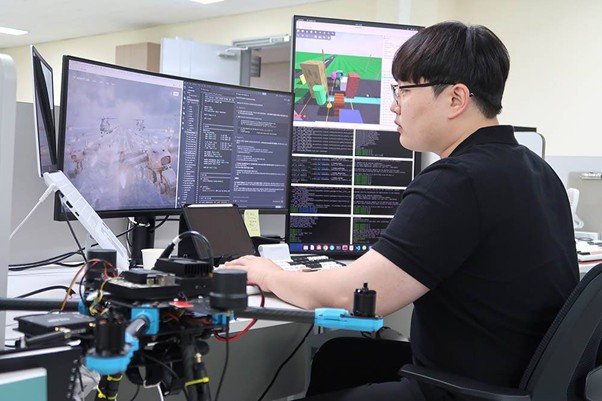
I oversee the development of AI autonomous flight technology for swarm drones. It is the task of enabling drones to independently perceive their environment, estimate their position, and plan their routes to fly safely. In detail, we develop technologies such as stereo vision, which estimates distance and depth using the visual disparity of two cameras without sensors like Radar or LiDAR; sensor fusion-based position estimation combining information from cameras and Inertial Measurement Unit (IMU) sensors; route planning and control; and swarm cooperative control. I oversee not only the development of individual algorithms but also the design of the entire system architecture, the integration between each module, and the verification process that narrows the gap between simulations and actual fields. Through this, we are making drones recognize and avoid obstacles using only cameras.
We are also integrating AI into autonomous flight technology. AI is utilized in various areas. AI performs the task of identifying and avoiding obstacles through the recognition of objects and surrounding situations. Adjusting the amount of pest control spraying is also the role of AI. When operated manually by a person, it is not easy to adjust the appropriate amount individually, but utilizing AIallows for automatic adjustment to the appropriate volume tailored to the surrounding environment.
Why is AI autonomous flight technology important in swarm drones?
AI autonomous flight technology is essential for a single person to simultaneously operate two or more drones and safely perform pest control tasks without colliding with obstacles in the complex environment of farmlands. In particular, the AI autonomous flight of swarm drones is a critical technology in that it is directly related to cost efficiency and economic viability.
Were there any difficulties during the AI autonomous flight development process?
The algorithm and technical aspects were relatively smooth. However, there was a lack of understanding regarding the hardware known as a drone. This was because I had no previous experience directly handling drones. To resolve this, we hired individuals with extensive drone operation experience and bridged the gap in technical experience. While I proposed algorithms and the direction of technology development, I collaborated with team members on the parts directly applied to and operating the drones. Thanks to this, we were able to shorten the development period.
What is the current development stage of the AI autonomous flight technology?
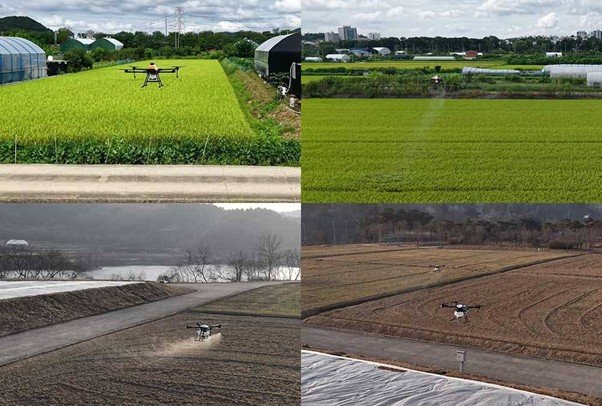
Development has been completed to a level capable of agricultural pest control. We verified the technological prowess, potential, and business viability by conducting a PoC with the Agricultural Research & Extension Services last year. We also confirmed effects such as a pest control cost reduction of over 60% and spraying an area more than 8 times larger in the same amount of time compared to existing single drones. These are the results obtained from flying autonomously in actual farmlands, rather than flying on a predetermined route in a restricted environment. Until now, we have demonstrated the technology focusing on the agricultural sector, but we are currently researching to expand into various domains such as disaster management and the defense industry.
MobilityLab, Capable of Everything From Design to Field Testing
What kind of environment is MobilityLab for developing AI autonomous flight technology?
MobilityLab provides an environment where one can directly participate in the entire process from algorithm design to field testing. In drone autonomous flight technology, algorithms researched and simulated at a desk often yield different results in actual fields. The same goes for flying only on predetermined routes in closed and restricted environments. Therefore, an environment where one can quickly test in the actual field is crucial. MobilityLab is an environment capable of practical-focused development where technology development or problem improvements can be immediately verified in the field.
The systematic work process is also an advantage. MobilityLab is adopting the 'systems engineering' methodology primarily used in the defense sector. It is an approach of first setting the final goal, organizing the technologies and systems needed to achieve it, and then initiating development. Because detailed tasks are carried out after the big picture is completed first, it is possible to enhance work efficiency and progress work systematically. In the case of MobilityLab, we set the ultimate goal of camera-based autonomous flight, and to achieve this, we are systematically organizing and developing various technologies such as stereo vision, position estimation, drone control, and communication.
Furthermore, one can view the autonomous flight development process as a single continuous flow. Unlike large corporations or research institutes where one is in charge of developing only a single part, you can broaden your perspective by participating in development while directly observing the entire system flow. Collaborating closely with colleagues in charge of perception, control, and hardware means that prompt feedback can be received when issues arise, which is also a huge help in developing AI autonomous flight technology. Research autonomy is also on the higher side. Since MobilityLab CEO Jack Chun is highly proactive in technology investments, if a new idea comes to mind during research or development, one can try it out without feeling burdened.
How is the company atmosphere?
It is an atmosphere where one can comfortably focus on work. The level of intimacy among members is also high. Because we are moving together towards a single goal despite being in different fields, we comfortably share opinions and debate while respecting each other. With many members of similar age and years of experience, a flat organizational culture has been established.
To Develop AI Autonomous Flight, Field Experience and a Broad Perspective Are Needed
What competencies do you think are necessary for AI autonomous flight development?
Mathematical foundations such as linear algebra, probability, and control, along with the fundamentals of robotics, must be solid. As for tools, an understanding of development environments like C++, Python, and Robot Operating System (ROS) 2, as well as perception and sensor fusion such as vision and Simultaneous Localization and Mapping (SLAM), is required. Equally important is the perseverance to debug problems occurring in actual hardware until the end, and the attitude of accepting and attempting to verify the differences between simulations and the field. Above all, one must understand the difference in perspective between the lab and the field. In the lab, the focus is on performance development and improvement, but in the field, how much actual performance is achieved is more important. A posture that understands these differences and approaches them with a broad view is necessary. Lastly, communication skills with personnel in other domains must also be equipped.
Do you have any advice for those preparing for the AI autonomous flight development field?
I recommend not stopping at learning concepts through papers or lectures, but attempting to conduct a project, even a small one, that directly connects everything from sensors to control and operates to the end. Experiencing the difference between simulations and the field firsthand through this will be of great help when carrying out practical work in the future. It is also crucial to cultivate a perspective that looks at the entire system rather than being bogged down by a single algorithm.
What are your future plans or goals?
Recently, physical AI, where robots directly perceive and act in physical environments, is gaining attention. In that autonomous flight is a technology that makes drones see, judge, and move on their own, I believe it is a highly versatile technology that can expand into all industrial sectors in the era of physical AI. Accordingly, by advancing AI autonomous flight technology, we intend to further elevate our technological level so that it can be applied to diverse areas. Until now, we have focused on agricultural pest control, but going forward, we will expand our scope of application to various fields such as forest fire fighting scenes or the defense industry. I will strive to ensure that MobilityLab's AI autonomous flight technology is disseminated more quickly and spreads across various fields.
By Man-hyuk Han (mh@itdonga.com)
- The drones independently navigate and avoid obstacles using technologies like stereo vision and sensor fusion. MobilityLab provides a systematic environment that allows immediate transition from algorithm design to real-world field testing.
- Emphasizing the importance of hands-on field experience, MobilityLab plans to expand its autonomous flight technology beyond agriculture into diverse industries such as disaster management and defense.
The startup talent we are introducing this time is JooHyoung Lee, the AI Autonomous Flight Development Team Leader at MobilityLab. MobilityLab is a deep-tech company developing swarm drone solutions based on artificial intelligence (AI) autonomous flight technology. AI autonomous flight is a technology where multiple drones recognize each other's positions and missions without central control, simultaneously flying while detecting and avoiding on-site obstacles.
MobilityLab introduced an agricultural pest control solution using AI autonomous flight swarm drones, and through a Proof of Concept (PoC) conducted with the Agricultural Research & Extension Services, it verified effects such as a pest control cost reduction of over 60% and the spraying of an area more than 8 times larger in the same amount of time compared to existing single drones.
We met Team Leader JooHyoung Lee, who oversees the development of AI autonomous flight technology at MobilityLab, to talk about swarm drone AI autonomous flight technology. Team Leader JooHyoung Lee conducted research related to the tracking of high-speed underwater moving objects at the Agency for Defense Development(ADD), and later expanded his research area to the fields of autonomous moving objects and cognitive and navigation systems. Since joining MobilityLab in December 2024, he has been in charge of the AI Autonomous Flight Development Team, overseeing the design, implementation, and field verification of autonomous navigation systems operating in real-world environments.
JooHyoung Lee, MobilityLabAI Autonomous Flight Development Team Leader / Source=IT DongA
From a Defense Researcher to an AI Autonomous Flight Developer
When did you join MobilityLab? What was the motivation for joining?
I joined in December 2024, during the early founding stage of MobilityLab. At that time, I had a strong desire to expand my experience by applying the technologies I had been researching to various industries outside of defense. Furthermore, I wanted to broaden my perspective by directly experiencing various processes from research to development and field application. Initially, I thought about founding a startup myself. However, there were quite a few bottlenecks during the preparation process. Therefore, I decided to join an early-stage startup, experience the growth process, and then challenge myself to start a business again. In doing so, I discovered MobilityLab and applied.
MobilityLab was developing swarm drones for agricultural pest control at the time, and I thought my research experience in autonomous moving objects, cognitive and navigation systems could contribute to solving technical challenges in agricultural fields. I decided to join MobilityLab because I could experience the entire product development process from technology development to real-world application, and because joining at the early stage of founding would allow me to take on more challenges.
It seems there would be many differences between the field of high-speed underwater moving objects you researched before joining and the swarm drone field.
The field I researched before joining was underwater communication technology, such as the tracking of high-speed underwater moving objects and ultra-long-distance underwater communication. This has similarities to the communication technology applied to swarm drones. This is because similar communication technologies are used for drones to determine each other's positions and movements during flight. Although the fields are different, there is a direct connection.
Drones Recognizing, Avoiding, and Flying Themselves: AI Autonomous Flight
What are your current responsibilities at MobilityLab?
I oversee the development of AI autonomous flight technology for swarm drones. It is the task of enabling drones to independently perceive their environment, estimate their position, and plan their routes to fly safely. In detail, we develop technologies such as stereo vision, which estimates distance and depth using the visual disparity of two cameras without sensors like Radar or LiDAR; sensor fusion-based position estimation combining information from cameras and Inertial Measurement Unit (IMU) sensors; route planning and control; and swarm cooperative control. I oversee not only the development of individual algorithms but also the design of the entire system architecture, the integration between each module, and the verification process that narrows the gap between simulations and actual fields. Through this, we are making drones recognize and avoid obstacles using only cameras.
We are also integrating AI into autonomous flight technology. AI is utilized in various areas. AI performs the task of identifying and avoiding obstacles through the recognition of objects and surrounding situations. Adjusting the amount of pest control spraying is also the role of AI. When operated manually by a person, it is not easy to adjust the appropriate amount individually, but utilizing AIallows for automatic adjustment to the appropriate volume tailored to the surrounding environment.
JooHyoung Lee developing AI autonomous flight technology / Source=IT DongA
Why is AI autonomous flight technology important in swarm drones?
AI autonomous flight technology is essential for a single person to simultaneously operate two or more drones and safely perform pest control tasks without colliding with obstacles in the complex environment of farmlands. In particular, the AI autonomous flight of swarm drones is a critical technology in that it is directly related to cost efficiency and economic viability.
Were there any difficulties during the AI autonomous flight development process?
The algorithm and technical aspects were relatively smooth. However, there was a lack of understanding regarding the hardware known as a drone. This was because I had no previous experience directly handling drones. To resolve this, we hired individuals with extensive drone operation experience and bridged the gap in technical experience. While I proposed algorithms and the direction of technology development, I collaborated with team members on the parts directly applied to and operating the drones. Thanks to this, we were able to shorten the development period.
What is the current development stage of the AI autonomous flight technology?
Development has been completed to a level capable of agricultural pest control. We verified the technological prowess, potential, and business viability by conducting a PoC with the Agricultural Research & Extension Services last year. We also confirmed effects such as a pest control cost reduction of over 60% and spraying an area more than 8 times larger in the same amount of time compared to existing single drones. These are the results obtained from flying autonomously in actual farmlands, rather than flying on a predetermined route in a restricted environment. Until now, we have demonstrated the technology focusing on the agricultural sector, but we are currently researching to expand into various domains such as disaster management and the defense industry.
Test site for AI autonomous flight-based swarm drones / Source=MobilityLab
MobilityLab, Capable of Everything From Design to Field Testing
What kind of environment is MobilityLab for developing AI autonomous flight technology?
MobilityLab provides an environment where one can directly participate in the entire process from algorithm design to field testing. In drone autonomous flight technology, algorithms researched and simulated at a desk often yield different results in actual fields. The same goes for flying only on predetermined routes in closed and restricted environments. Therefore, an environment where one can quickly test in the actual field is crucial. MobilityLab is an environment capable of practical-focused development where technology development or problem improvements can be immediately verified in the field.
The systematic work process is also an advantage. MobilityLab is adopting the 'systems engineering' methodology primarily used in the defense sector. It is an approach of first setting the final goal, organizing the technologies and systems needed to achieve it, and then initiating development. Because detailed tasks are carried out after the big picture is completed first, it is possible to enhance work efficiency and progress work systematically. In the case of MobilityLab, we set the ultimate goal of camera-based autonomous flight, and to achieve this, we are systematically organizing and developing various technologies such as stereo vision, position estimation, drone control, and communication.
Furthermore, one can view the autonomous flight development process as a single continuous flow. Unlike large corporations or research institutes where one is in charge of developing only a single part, you can broaden your perspective by participating in development while directly observing the entire system flow. Collaborating closely with colleagues in charge of perception, control, and hardware means that prompt feedback can be received when issues arise, which is also a huge help in developing AI autonomous flight technology. Research autonomy is also on the higher side. Since MobilityLab CEO Jack Chun is highly proactive in technology investments, if a new idea comes to mind during research or development, one can try it out without feeling burdened.
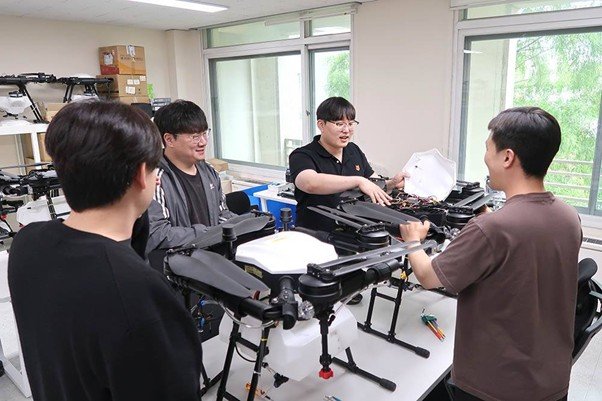
A scene from a development-related meeting. Focusing on work in a comfortable environment with a flat organizational culture / Source=IT DongA
How is the company atmosphere?
It is an atmosphere where one can comfortably focus on work. The level of intimacy among members is also high. Because we are moving together towards a single goal despite being in different fields, we comfortably share opinions and debate while respecting each other. With many members of similar age and years of experience, a flat organizational culture has been established.
To Develop AI Autonomous Flight, Field Experience and a Broad Perspective Are Needed
What competencies do you think are necessary for AI autonomous flight development?
Mathematical foundations such as linear algebra, probability, and control, along with the fundamentals of robotics, must be solid. As for tools, an understanding of development environments like C++, Python, and Robot Operating System (ROS) 2, as well as perception and sensor fusion such as vision and Simultaneous Localization and Mapping (SLAM), is required. Equally important is the perseverance to debug problems occurring in actual hardware until the end, and the attitude of accepting and attempting to verify the differences between simulations and the field. Above all, one must understand the difference in perspective between the lab and the field. In the lab, the focus is on performance development and improvement, but in the field, how much actual performance is achieved is more important. A posture that understands these differences and approaches them with a broad view is necessary. Lastly, communication skills with personnel in other domains must also be equipped.
Do you have any advice for those preparing for the AI autonomous flight development field?
I recommend not stopping at learning concepts through papers or lectures, but attempting to conduct a project, even a small one, that directly connects everything from sensors to control and operates to the end. Experiencing the difference between simulations and the field firsthand through this will be of great help when carrying out practical work in the future. It is also crucial to cultivate a perspective that looks at the entire system rather than being bogged down by a single algorithm.
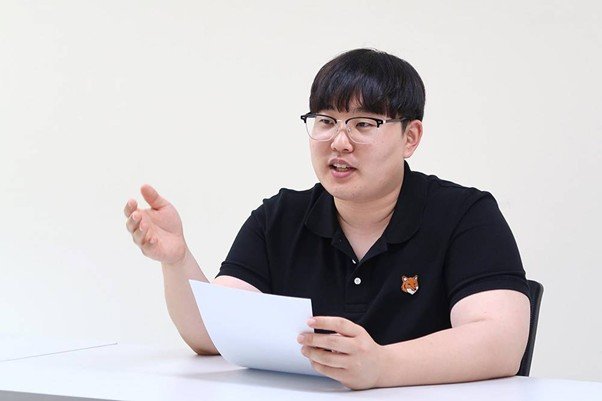
JooHyoung Lee explaining MobilityLab and AI autonomous flight technology / Source=IT DongA
What are your future plans or goals?
Recently, physical AI, where robots directly perceive and act in physical environments, is gaining attention. In that autonomous flight is a technology that makes drones see, judge, and move on their own, I believe it is a highly versatile technology that can expand into all industrial sectors in the era of physical AI. Accordingly, by advancing AI autonomous flight technology, we intend to further elevate our technological level so that it can be applied to diverse areas. Until now, we have focused on agricultural pest control, but going forward, we will expand our scope of application to various fields such as forest fire fighting scenes or the defense industry. I will strive to ensure that MobilityLab's AI autonomous flight technology is disseminated more quickly and spreads across various fields.
By Man-hyuk Han (mh@itdonga.com)

![한적한 시골 단위농협… 알고보니 ‘대포통장 발급 전국 2위’[히어로콘텐츠/히든②-下]](https://dimg.donga.com/c/138/175/90/1/wps/NEWS/IMAGE/2026/06/23/134161455.1.jpg)




 About Dong-A Ilbo