

Labor law tests subcontractor employer boundaries
Labor law tests subcontractor employer boundaries
Posted June. 23, 2026 08:08,
Updated June. 23, 2026 08:08
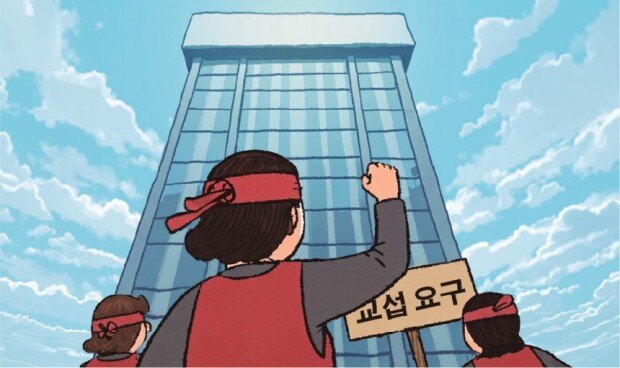
South Korea’s revised labor law, which broadens the definition of a “real employer” in disputes involving subcontracted workers, has passed the 100-day mark. Legal reviews suggest public-sector welfare programs for vulnerable groups and subcontracted workers may be cited as grounds for recognizing parent companies as employers.
During the first 100 days since the law took effect, about 160,000 unionized subcontracted workers filed bargaining requests targeting 439 parent-company workplaces. The government, however, said there was no sign of a surge in bargaining requests or fragmented negotiations.
According to documents obtained by Rep. Yoon Young-seok of the People Power Party from Korea Land and Housing Corp. (LH), labor law firms providing legal advice concluded that LH’s rent cap system for public rental housing could be used as a basis for determining employer status. Under the system, LH sets annual limits on rent increases to prevent sharp spikes in maintenance costs for tenants, many of whom are from vulnerable groups. Apartment management companies that exceed the cap receive penalty points. The policy, intended to protect low-income tenants, could be interpreted as evidence of a degree of control over operations that supports bargaining claims by subcontracted workers employed by management companies, including apartment office managers and staff.
Korea Railroad Corp. (KORAIL) has also been advised that rest areas provided for subcontracted workers could be used as evidence in establishing “real employer” status.
As political debate intensifies over revisions to the so-called Yellow Envelope Act, the Ministry of Employment and Labor and the National Labor Relations Commission said at a briefing in Sejong on Monday that labor disputes had entered a more stable phase. Officials said new bargaining requests dropped sharply after the first month of enforcement. In March, 363 parent companies received bargaining requests, followed by 42 in April and 23 in May.
Still, industry concerns persist that disputes over the scope of “real employer” status and bargaining subjects are only just beginning. Companies say that activities once treated as peripheral, including outsourced catering and cleaning services, are increasingly being cited to argue for broader employer responsibility, raising expectations of wider labor tensions ahead.
Hye-Ryung Choi herstory@donga.com

![한적한 시골 단위농협… 알고보니 ‘대포통장 발급 전국 2위’[히어로콘텐츠/히든②-下]](https://dimg.donga.com/c/138/175/90/1/wps/NEWS/IMAGE/2026/06/23/134161455.1.jpg)


![금고 전무 “통장 풀었다 ㅎㅎ” 피싱 신고자 신상 508번 조직에 넘겨[히어로콘텐츠/히든②-上]](https://dimg.donga.com/c/138/175/90/1/wps/NEWS/IMAGE/2026/06/22/134161350.1.jpg)



 About Dong-A Ilbo