

Shell companies fuel surge in fraud
Shell companies fuel surge in fraud
Posted June. 23, 2026 08:08,
Updated June. 23, 2026 08:08
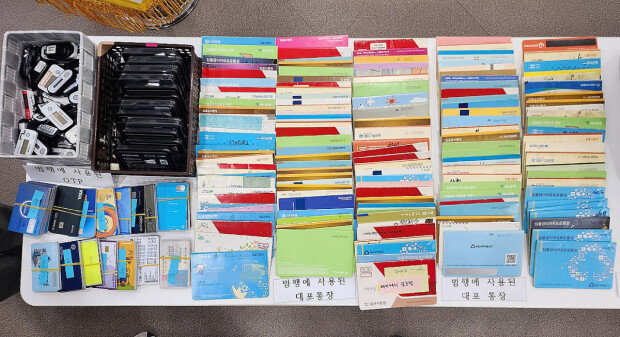
An elderly man in his 80s, struggling to pay his wife’s medical bills, was deceived by a fake investment website promising high returns and transferred 45 million won, nearly his remaining housing deposit, to an account he was instructed to use. The account was linked to a shell company controlled by a criminal network. Authorities have identified at least 189 victims, with total losses of 3.9 billion won across 30 accounts tied to the same shell company.
A special report by the Dong-A Ilbo Hero Content Team, which analyzed 126,866 voice phishing accounts registered with the Financial Supervisory Service over the past five years and interviewed 58 victims and individuals linked to borrowed-name accounts, found that fraudulent accounts are being produced and distributed through an increasingly organized system.
An estimated 320,000 such accounts are opened each year, or about 876 a day. In the past, criminals often relied on stolen or purchased IDs from homeless people or undocumented migrants. More recently, they have shifted to shell companies set up solely to supply fraudulent accounts, sharply increasing supply.
Unlike personal accounts, shell-company accounts have virtually no transfer limits, allowing criminals to move tens of millions of won in illicit funds at once. They can also be used to generate virtual accounts, enabling new accounts to be created faster than victims can report them. Voice phishing and online gambling scams have flourished in part because of this infrastructure, which functions as a financial pipeline for criminal proceeds.
Setting up such shell companies is relatively easy. Operators rent a mailing address for about 10,000 won a month and register a non-office business, often listing e-commerce as the main activity. Even without staff or inventory, they pass bank screening by claiming they need accounts for online sales. A review of 17,000 newly registered voice phishing accounts this year found that the same individual was listed as the representative of the five most frequently flagged companies, suggesting one operator was running multiple shell firms under different names and addresses to mass-produce accounts.
Oversight remains weak. The investigation found cases in which shell companies were shut down by the National Tax Service, yet their accounts continued to be used in fraud schemes. The tax authority said account closure falls under the Financial Services Commission, while the commission said accounts cannot be closed unless the account holder reports them voluntarily.
Weak supervision at secondary financial institutions has also allowed them to serve as conduits for fraudulent accounts, with some effectively becoming hubs for criminal activity. One Saemaul Geumgo branch with about 10 employees reportedly issued 126 fraudulent accounts over three years and eight months.
Victims include some of the most financially vulnerable: a 68-year-old care worker who lost 9 million won in retirement savings, a 59-year-old housewife who lost 15 million won set aside for her daughter’s wedding, and a high school student who used gambling sites. The report urges authorities to move beyond jurisdictional disputes and treat fraudulent accounts as a shared priority, targeting what it calls the central artery of financial crime. Only then, it argues, can investment fraud and voice phishing schemes be effectively curbed.

![한적한 시골 단위농협… 알고보니 ‘대포통장 발급 전국 2위’[히어로콘텐츠/히든②-下]](https://dimg.donga.com/c/138/175/90/1/wps/NEWS/IMAGE/2026/06/23/134161455.1.jpg)


![금고 전무 “통장 풀었다 ㅎㅎ” 피싱 신고자 신상 508번 조직에 넘겨[히어로콘텐츠/히든②-上]](https://dimg.donga.com/c/138/175/90/1/wps/NEWS/IMAGE/2026/06/22/134161350.1.jpg)



 About Dong-A Ilbo