

Parties flood races with overlapping pledges
Parties flood races with overlapping pledges
Posted June. 01, 2026 08:27,
Updated June. 01, 2026 09:41
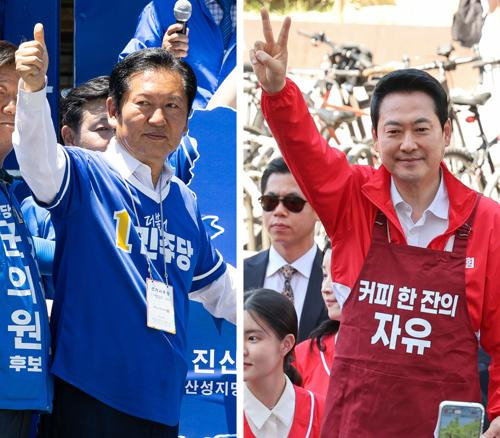
Democratic Party of Korea candidate Jeong Won-o, running for Seoul mayor, unveiled a redevelopment vision for Yongsan on May 22, promising to bring a United Nations artificial intelligence hub to the district. The Lee Jae-myung administration is pursuing a bid to host the proposed center in South Korea by consolidating AI-related functions currently spread across several U.N. agencies. Jeong said securing the project would help establish Yongsan as a focal point of the country's AI industry.
But Jeong is hardly alone in making the AI hub part of his campaign platform ahead of the June 3 local elections. Fellow Democratic Party of Korea candidates Jeon Jae-soo in Busan, Park Chan-dae in Incheon and Park Soo-hyun in South Chungcheong Province have all pledged to bring the same project to their regions. Similar promises have appeared in lower-level races, including the Goyang mayoral contest, where candidate Min Gyeong-seon has put forward the same proposal. As election day approaches, both major parties are drawing criticism for a growing number of "zero-sum pledges," with candidates promising to land the same government-backed projects or institutions in competing regions, sometimes within the same party. Critics say the local elections have become increasingly opaque, with little scrutiny of campaign promises, while party leaders remain focused on mobilizing supporters with partisan messages such as "eliminating insurrectionist forces" and "stopping dictatorship" rather than engaging voters on policy.
Among People Power Party candidates, Park Dong-sik in Sacheon, Han Gyeong-ho in Jinju and Yu Myeong-hyeon in Sancheong have each promised to attract an aerospace industry cluster. In another example of overlapping pledges, Busan mayoral candidate Park Hyeong-joon and Geoje mayoral candidate Kim Seon-min have both vowed to develop their cities as key support bases for the Gadeok New Airport.
The spread of duplicate campaign promises reflects a lack of internal screening and coordination by political parties, critics say, allowing candidates to make ambitious pledges with little regard for feasibility. Lee Jae-mook, a political science professor at Hankuk University of Foreign Studies, said local elections have become increasingly subordinate to national politics, weakening incentives for candidates to craft policies tailored to local needs. He added that party leadership on both sides has also struggled to coordinate policy priorities at the national level.
The problem was especially evident in this election cycle, which many observers have described as one of the least informative local elections in recent memory. Televised debates for major races, including the Seoul and Ulsan mayoral contests and the National Assembly by-election in Busan's Buk Gap district, were not held until the evening before early voting began. In Seoul, Daegu and Gyeonggi Province, candidates failed to agree on additional debates, leaving voters with only a single televised forum.
Meanwhile, the National Election Commission said Sunday that turnout during the two-day early voting period on May 29 and 30 reached 23.51%. The figure was 2.89 percentage points higher than the 20.62% recorded in the local elections four years ago, marking the highest early-voting turnout ever for a local election.
구민기 기자 koo@donga.com · 이채완 기자 chaewani@donga.com

![충분히 자도 계속 피곤한 이유?…뜻밖의 원인 찾았다[건강팩트체크]](https://dimg.donga.com/c/138/175/90/1/wps/NEWS/IMAGE/2026/05/29/134016517.3.jpg)

![[단독]파산신청 급증…압류 안되는 ‘생계비 계좌’ 두달새 2배로](https://dimg.donga.com/c/138/175/90/1/wps/NEWS/IMAGE/2026/06/01/134026304.1.jpg)


 About Dong-A Ilbo