

Hegseth praises South Korea's burden sharing
Hegseth praises South Korea's burden sharing
Posted June. 01, 2026 08:27,
Updated June. 01, 2026 08:27
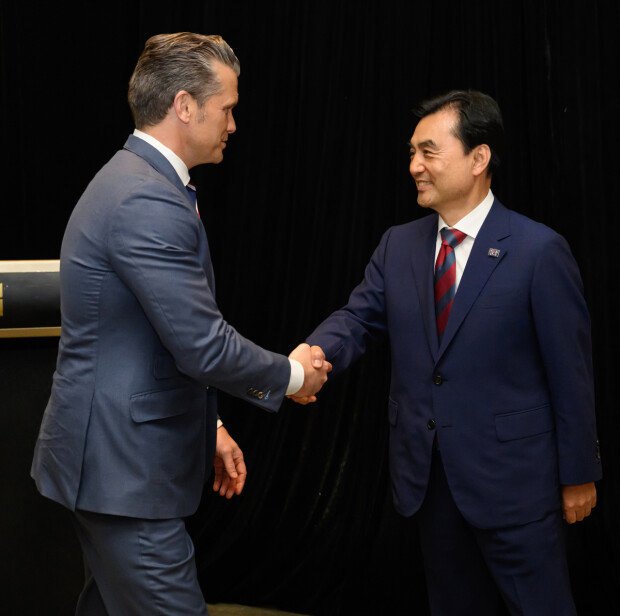
U.S. Defense Secretary Pete Hegseth on Saturday praised South Korea's increased defense spending as an example for other allies and welcomed Seoul's push to take over wartime operational control of its military.
Speaking at the Shangri-La Dialogue in Singapore, Hegseth cited South Korea as a leading example of alliance burden-sharing. "If you want to see what burden-sharing looks like in practice, look at South Korea," he said. "South Korean President Lee Jae-myung's decision to increase defense spending to 3.5% of gross domestic product, a level emerging as a new international benchmark, and to assume greater responsibility for conventional defense reflects a clear-eyed assessment of the security environment."
He said the decision was essential to South Korea's security and prosperity and reflected a willingness to confront strategic realities directly. Hegseth also praised what he described as South Korea's pragmatism and leadership.
"I applaud the pragmatism and leadership South Korea has shown," he said. "If other allies and partners follow this path, the region will be far more stable and secure."
He added that allies prepared to take on a larger share of defense responsibilities would benefit from faster approvals of U.S. arms sales, expanded intelligence-sharing and deeper industrial cooperation.
Asked after the speech about the transfer of wartime operational control, Hegseth welcomed the effort, saying it was encouraging to see allies seeking greater authority over their own defense. "That is something we want to continue encouraging," he said. He added, however, that the process must also respect longstanding U.S. military operational plans and the decades of work invested by American service members.
On China, Hegseth struck a notably softer tone than he did at last year's forum. "There is legitimate concern about China's historic military buildup and its expanding military activities across the Indo-Pacific and beyond," he said. "We seek a sustainable balance of power in which no country, including China, can exercise hegemony or threaten the security and prosperity of the United States and its allies."
The comments marked a contrast with last year's Shangri-La Dialogue, when Hegseth sharply criticized China as a "real threat." He also cited what he described as constructive outcomes from the U.S.-China summit held in Beijing on May 14, saying bilateral relations were now "in the best shape they have been in for years."
Woo-Sun Lim imsun@donga.com


![[오늘의 운세/6월 14일]](https://dimg.donga.com/c/138/175/90/1/wps/NEWS/IMAGE/2026/06/13/134104335.1.jpg)




 About Dong-A Ilbo