

Lee's approval rating falls after local elections
Lee's approval rating falls after local elections
Posted June. 13, 2026 08:25,
Updated June. 13, 2026 08:25
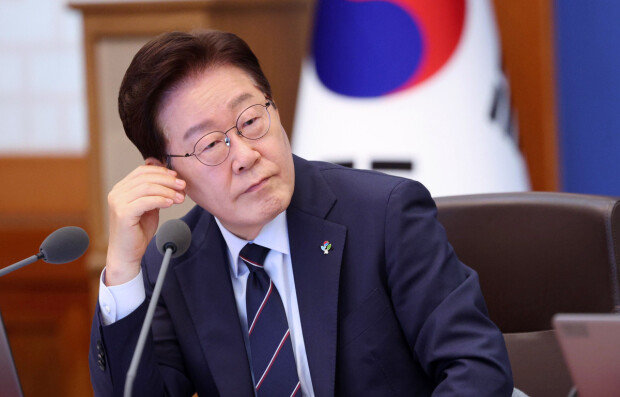
President Lee Jae-myung's approval rating fell to 57% in the first Gallup Korea survey conducted since the June 3 local elections, marking a 7-percentage-point drop from three weeks earlier.
According to the poll, conducted by Gallup Korea from June 9-11 and released Thursday, Lee's job approval rating stood at 57%. The survey was based on telephone interviews and carries a margin of error of plus or minus 3.1 percentage points at a 95% confidence level. The result was down from 64% in the previous survey released on May 22, representing the sharpest decline since Lee took office in June last year. The previous largest drop came in the second week of December, when his approval rating fell six percentage points, from 62% to 56%, amid allegations involving gifts and financial support linked to the Unification Church.
Negative assessments of Lee's performance also climbed, rising from 28% to 35% over the same period. Among respondents who disapproved of his job performance, the most frequently cited reasons were concerns over election mismanagement and allegations of electoral irregularities involving the National Election Commission (16%), economic hardships and the weak won (14%), and real estate policy (9%). Gallup Korea noted that Lee's approval rating had fallen below 60% for the first time in four months, attributing the decline in part to public backlash over the ballot shortage controversy during the local elections.
Support for the Democratic Party of Korea stood at 41%, while the People Power Party recorded 29%. The Democratic Party's support fell 4 percentage points from three weeks earlier, while support for the People Power Party rose 7 points. As a result, the gap between the two parties narrowed to 12 percentage points, down from 23 points in the previous survey.
Asked about the ballot shortage that emerged during the local elections, 67% of respondents said it amounted to an infringement on voting rights, while 25% viewed it as evidence of an attempt to manipulate the election. Responses varied sharply along ideological lines. Among self-identified progressives, 89% described the episode as a case of election mismanagement, a view shared by 72% of centrists. Among conservatives, however, 44% regarded it as unlawful interference in the electoral process. Opinion on holding a nationwide rerun election was nearly evenly divided, with 44% in favor and 48% opposed.
Dong-Joo Cho djc@donga.com


![국비 지원받아 무료로 중장비 면허 딴 60대 女농사꾼[은퇴 레시피]](https://dimg.donga.com/c/138/175/90/1/wps/NEWS/IMAGE/2026/06/13/134102134.5.jpg)



 About Dong-A Ilbo