

Export boom fails to lift employment
Export boom fails to lift employment
Posted June. 12, 2026 08:20,
Updated June. 12, 2026 08:20
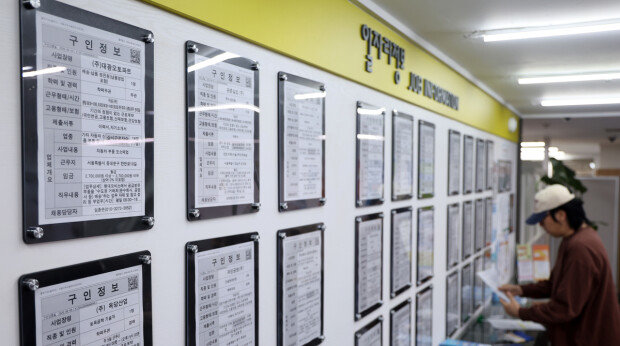
South Korea's job market contracted in May for the first time since the aftermath of the martial law crisis, as the prolonged war in the Middle East increasingly weighed on employment across a broad range of industries. The decline came despite robust export growth driven by an unprecedented semiconductor boom, deepening concerns over so-called jobless growth.
According to data released Thursday by the National Data Agency, the number of employed people stood at 29.12 million in May, down 40,000 from a year earlier. It marked the first year-over-year decline since December 2024, when employment fell by 52,000 as domestic demand weakened in the wake of the martial law turmoil and government-backed year-end job programs came to an end.
Employment increased by more than 200,000 from a year earlier in both February and March, but the gain slowed to 74,000 in April before turning negative in May. The employment rate fell 0.5 percentage point from a year earlier to 63.3%, extending its decline to a second straight month. It was the sharpest drop since February 2021, when the rate fell 1.4 percentage points.
The deterioration in employment was driven by the broadening economic impact of the Middle East conflict. Manufacturing, a key engine of South Korea's labor market, lost 140,000 jobs from a year earlier in May, the steepest decline since February 2019, when the sector shed 151,000 positions. Manufacturing employment has now fallen for 23 consecutive months, with the pace of losses more than doubling from April's decline of 55,000.
Exports continue to set new records, but the labor market has yet to share in that momentum. Much of the export growth has come from semiconductors, an industry that contributes relatively little to overall job creation. Bin Hyun-jun, commissioner of social statistics at the National Data Agency, said semiconductor-related jobs account for only about 4% of manufacturing employment. He added that employment declines also deepened in industries including food production and automobiles.
The construction sector lost 43,000 jobs from a year earlier, extending its downturn to 25 consecutive months. Higher raw material costs and other pressures that have built up since the outbreak of the Middle East conflict accelerated the decline, compared with a loss of 8,000 jobs in April.
Deputy Prime Minister and Finance Minister Koo Yun-cheol said uncertainty surrounding employment conditions is growing as the Middle East conflict drags on, while young people face mounting challenges and weakness in manufacturing, construction, agriculture and fisheries continues to deepen. “I urge all ministries to remain on high alert and respond with the utmost urgency,” Koo said.
세종=김수연 syeon@donga.com







 About Dong-A Ilbo